Get Full Government Meeting Transcripts, Videos, & Alerts Forever!
Get email alerts on the Dbi Reform topic
No spam. Unsubscribe anytime.
DBI unveils multi‑year permit‑reform blueprint; commission delays final approval until fee study is complete
Summary
DBI Director Esam Hassan presented a multi‑year Business Process Reengineering implementation plan March 19, estimating significant automation and staffing needs; the commission continued the item to next month so commissioners can review a pending fee study and a detailed MIS cost breakdown.
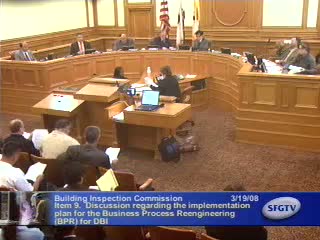
The Department of Building Inspection presented a detailed multi‑year implementation plan for Business Process Reengineering (BPR) at the commission’s March 19 meeting, then the commission voted to continue formal approval until it reviews a pending external fee study and a more explicit MIS/automation cost breakdown.
Director Esam Hassan told the commission the plan translates roughly 180 BPR recommendations into staff assignments, task forces, customer service stations, online permitting pilots and an automation roadmap. Hassan said the full suite of automation and process changes would likely be rolled out in modules and estimated — at a high level — that fully implementing the plan could cost on the order of tens of millions over several years. "We estimate that it would take approximately $30,000,000 over the next 3 years or so to accomplish all of those goals," he said.
What the plan includes: Hassan outlined immediate operational changes (centralized cashiering; registration and permit‑issuance stations; a permit numbering scheme; senior‑level inspectors at counters for complex field issues), performance targets (e.g., delivering initial checklists for small projects within 10 business days; committing to 90% of inspections within 48 hours) and an automation roadmap (workflow tracking, online plan submittal, inspection scheduling, handheld devices for inspectors, and document management).
Funding and tradeoffs: Commissioners and stakeholders debated sequencing and financing. Some commissioners favored implementing low‑cost or no‑cost changes now and phasing in automation and staffing after fee adjustments; others and many industry speakers argued the reforms should be implemented comprehensively now to avoid undermining systemwide improvements. Commissioner Sattari urged a conservative budgeting approach and stretching heavy investments over more years if necessary; others said industry groups signaled support for fee increases to fund the work.
Public input: More than a dozen architects, builders and industry representatives urged the commission not to piecemeal the plan, arguing that integrated reforms and automation together will deliver efficiency and revenue. Several commenters offered to support fee increases to enable implementation, and trade associations offered to participate in follow‑up task forces.
Commission action: After debate, the commission voted to continue the BPR implementation decision to next month and requested that DBI provide (1) a detailed MIS/automation cost breakout that separates one‑time implementation costs from recurring staffing costs and (2) the results of the external fee study that will indicate revenue availability to support proposed staffing and automation.
Next steps: DBI will return with the fee‑study results and a more granular automation budget so the commission can decide phasing and staffing requests in context of realistic revenues.
— Reporting from the Building Inspection Commission meeting on March 19, 2008