Get Full Government Meeting Transcripts, Videos, & Alerts Forever!
Get email alerts on the Green Building topic
No spam. Unsubscribe anytime.
Commission backs blended green‑building ordinance, urges safeguards for existing buildings
Summary
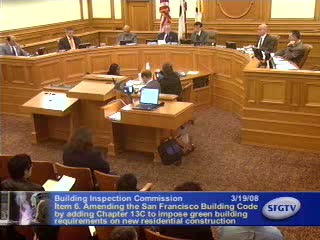
The Building Inspection Commission voted March 19 to send a Code Advisory Committee “hybrid” of the mayor’s and Supervisor Aaron Peskin’s green‑building ordinances to the Board of Supervisors with commission comments addressing historic buildings, exemptions and feasibility concerns.
The San Francisco Building Inspection Commission voted March 19 to send a blended version of two proposed green‑building ordinances to the Board of Supervisors, urging the city to protect existing historic buildings and provide clear hardship exemptions.
The commission reviewed two measures: a mayoral ordinance to add Chapter 13C to the San Francisco Building Code to phase in green requirements for new construction and significant alterations; and a Supervisor Aaron Peskin ordinance proposing LEED Gold (or equivalent) requirements for projects over prescribed size thresholds. Chief Building Inspector Lawrence Kornfield told the commission the Code Advisory Committee produced a hybrid that harmonizes core elements from both drafts, and that the hybrid includes technical corrections the committee requested.
Why it matters: Commissioners and public speakers framed the legislation as a major step toward the city’s climate goals but warned it must not unintentionally incentivize demolition of existing buildings that embody significant material and energy resources. “The greenest building that exists today is one that is already built,” Supervisor Aaron Peskin told the commission, urging language that credits adaptive reuse and historic fabric.
Supporters from industry and the profession outnumbered critics at the hearing. Jennifer Devlin, president of the AIA San Francisco chapter, said the chapter — representing 2,500 architects in San Francisco and Marin County — endorses the legislation and the targets. Ken Cleveland of the Building Owners and Managers Association read a letter from Phil Williams, chair of the Mayor’s Green Building Task Force, endorsing the ordinance and the Code Advisory Committee’s proposed modifications.
Staff and task‑force members presented cost guidance used in drafting the rules. A staff representative cited industry data from the U.S. Green Building Council indicating that moving from LEED certified to silver adds roughly 1 percent to construction cost and that silver to gold can add roughly 2–4 percent, depending on project size and timing. Staff also noted California’s Title 24 energy code already narrows the gap between baseline practice and LEED energy requirements.
On exemptions and implementation, Kornfield said the hybrid ordinance includes explicit exemptions for city projects covered under Chapter 7 of the Environment Code and grants the Director of Building Inspection authority to issue hardship or feasibility exemptions in specified circumstances; the hybrid also contains an explicit exemption where compliance would compromise the historic integrity of a structure.
Action taken: After discussion, Commissioner Walker moved to support the Code Advisory Committee’s hybrid version with the commission’s comments on historic resources and hardship mechanisms. The motion carried by voice vote and the commission voted to forward the hybrid ordinance and its comments to the Board of Supervisors for further review and city‑attorney analysis.
What’s next: The Board of Supervisors will receive the commission’s recommendations and the city attorney will review the final language when it is transmitted. Staff said the ordinance as introduced adopts findings that reference California Health and Safety Code section 17958.5 and that the ordinance’s phased standards become effective 90 days after enactment and increase over a five‑year period.
— Reporting from the Building Inspection Commission meeting on March 19, 2008