Get Full Government Meeting Transcripts, Videos, & Alerts Forever!
Get email alerts on the Dust Control Ordinance topic
No spam. Unsubscribe anytime.
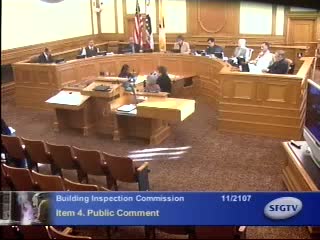
Building Inspection Commission delays citywide dust-control ordinance for further study
Summary
The commission voted 4–3 to continue consideration of a proposed ordinance that would require dust-control measures for construction and require health-department approval of plans for larger sites; commissioners asked for cost, staffing and impact analyses before Dec. 19.
The San Francisco Building Inspection Commission voted 4–3 on Nov. 21 to continue consideration of a proposed ordinance that would add dust-control requirements to the San Francisco Building Code and add Article 22b to the San Francisco Health Code.
The ordinance, introduced by staff and the Code Advisory Committee, would require contractors to control construction dust citywide and would require project sponsors for sites above a specified threshold to submit a dust-control plan for Department of Public Health approval. Staff said the advisory committee recommended raising the plan-submission threshold from a quarter-acre in the draft to a half-acre.
Lawrence Kornfield, Chief Building Inspector, said the change is intended to allow DBI to notify permittees of dust-control obligations and to enforce compliance "if complaints are received at the building department." Amy Brownell of the Department of Public Health said the health department "strongly supports this legislation," citing findings that particulate matter contributes to serious respiratory harms and noting the policy aims to reduce airborne particulates from construction.
Opponents on the commission and members of the Code Advisory Committee raised concerns about enforcement, cost and potential misuse as a nuisance tool. One commissioner said the ordinance could let "one person make a phone call and the job gets closed down," while CAC members warned enforcement and staffing impacts at the health department were unclear.
Commissioners who supported delaying the item sought additional information on: (1) quantitative estimates of air-quality improvement and the public-health benefit, (2) the cost impacts to small and typical city construction projects, and (3) the department staffing and operational impact of complaint-driven enforcement. Director's staff and presenters agreed to report back; the commission continued the item to its Dec. 19 meeting.
The commission's action was procedural: the item was continued for further study and no ordinance language was adopted. The motion to continue passed on a 4–3 vote.