Get Full Government Meeting Transcripts, Videos, & Alerts Forever!
Get email alerts on the Budget topic
No spam. Unsubscribe anytime.
Board hears first reading of $73.7 million PEAF budget; CAC urges more social workers and targeted investments
Summary
The superintendent’s proposed 2018–19 Public Education Enrichment Fund allocation totals $73,690,000. Staff and the PEAF Community Advisory Committee described program priorities and recommended increases in social workers/nurses, continued SLAM funding, multilingual pathways and measures to reduce sports concussions.
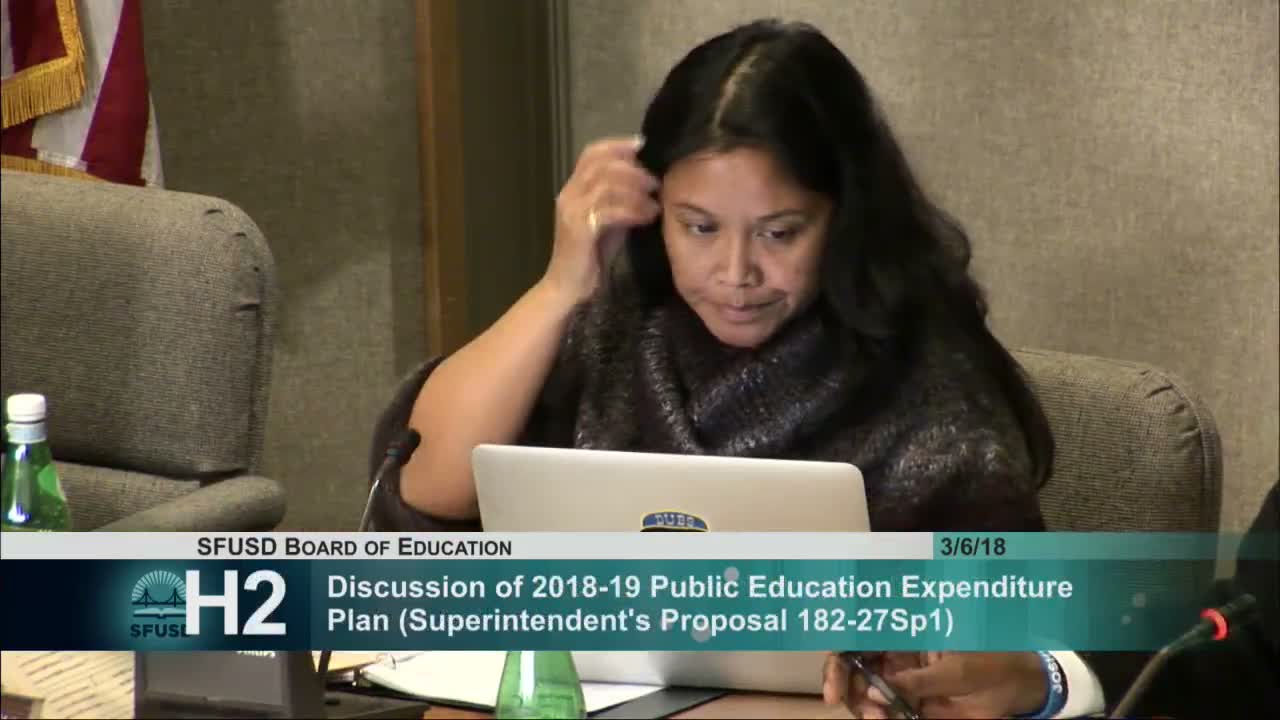
The San Francisco Unified School District board received the superintendent’s first reading of the 2018–19 Public Education Enrichment Fund (PEAF) expenditure plan on March 6. Kathy Fleming, director of the PEAF office, said the district’s allocation totals $73,690,000, representing two‑thirds of the PEAF pool; the other one‑third funds universal pre‑K and is managed by the city’s Office of Early Care and Education.
Fleming outlined the budget structure: PEAF revenue is split equally between SLAM (sports, libraries, arts and music) and the ‘third third’ that funds student‑and‑family support, academic supports and infrastructure (including a reduced reserve fund). A $4 million revenue increase for 2018–19 is largely allocated to salary and benefits. The proposal shifts three administrative STEM positions and funding for formative assessments out of PEAF into the unrestricted general fund and brings approximately 7.5 FTE school nurses and social workers into the student support professionals program.
PEAF staff presented two new public documents: the 2016–17 PEAF annual report and an elementary school arts profile that includes one‑page profiles for each of the district’s 72 elementary schools. The PEAF Community Advisory Committee (CAC) co‑chairs, Paul Monge and Fawzia Bridal Kader, summarized CAC recommendations: preserve SLAM service levels, prioritize direct services to students, reallocate redundant central office VAPA administrative staffing to school sites, increase social workers and nurses (the CAC recommended a minimum of 1 FTE per school), expand multilingual pathways (including pilots in Arabic and Vietnamese), and pursue measures to reduce concussions in tackle football and other sports.
Public speakers urged investment in language pathways and workforce supports—one speaker recommended piloting a driver‑training program to help transitional age youth overcome employment barriers. Board members asked for clearer presentation of dollar amounts by category in the annual report; staff said supporting materials in the board packet and linked charts provide detailed line items and that changes since first reading would be highlighted at second reading.
Staff said some new investments will be funded from carryover and realignment: baseline increases to the African American Achievement and Leadership Initiative and $200,000 added for supports for students with incarcerated parents and homeless youth. Fleming said most of the revenue increase is dedicated to salary and benefits, with program‑level increases including about $711,000 more in SLAM for FY 2018–19.
Fleming and PEAF staff committed to provide written responses to board questions and to present any changes at second reading, scheduled for the following week. Commissioners repeatedly called for transparency on how PEAF funds are used across city‑managed pre‑K programs and asked the CAC and staff to track outcomes for newly funded initiatives.