Get Full Government Meeting Transcripts, Videos, & Alerts Forever!
Get email alerts on the Geotechnical Reports topic
No spam. Unsubscribe anytime.
DBI staff outlines when geotechnical reports and peer review are required under city and state rules
Summary
Deputy Director Wing Lau and structural engineer Ray Lui reviewed code triggers — including grading, seismic hazard zones, and landslide-susceptible areas — that require geotechnical reports and outside peer review; commissioners urged clearer guidance for hillside projects and staff capacity increases.
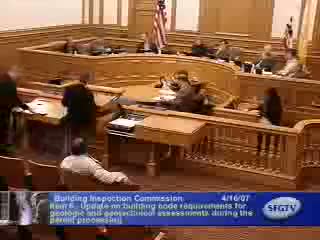
Deputy Director Wing Lau and structural engineer Ray Lui told the Building Inspection Commission on April 16 that city and state codes already require geotechnical (soil) reports for many projects and that additional peer review is triggered in landslide or liquefaction zones.
Lau and Lui cited code provisions and guidance the department relies on: a building-code provision described in the presentation (referred to as Section 106.3, item 15) that requires geotechnical reports for significant grading, excavation, special foundations or projects in seismic-hazard zones; Section 1804 provisions for liquefaction/landslide triggers; Section 1805 tables governing allowable bearing pressures for foundation design; Special Publication 117 and state seismic-hazard mapping updates; and the Bloom (Blume) Report mapping of slide-prone areas. They noted local slope-protection areas (Edgehill, Mount Sutro and others) that add committee-review or additional requirements for projects in those zones.
Commissioners asked technical questions about what constitutes expansive versus non-expansive soils, when a simple geotechnical review suffices and when a more detailed geological investigation is required for hillsides that could affect adjacent properties. Staff acknowledged variability in the level of investigation and said Chapter 18 specifies criteria for geological reports; they committed to develop clearer internal guidance tying investigation scope to site risk and to pursue stronger internal geotechnical expertise.
Director-level staff said they will request a dedicated geotechnical engineering position in the upcoming budget to build in-house capacity for reviewing maps, past memos and policy. Staff emphasized that in recent years DBI has required geotechnical reports and outside peer review for major developments in areas like Hunters Point, Mission Bay and other landslide‑susceptible districts.
The commission did not change code at this meeting but directed staff to produce clearer guidance on the level of geotechnical investigation required for hillside and high-risk sites and to return with recommended procedures.