Get Full Government Meeting Transcripts, Videos, & Alerts Forever!
Get email alerts on the Achievement Gap topic
No spam. Unsubscribe anytime.
SF superintendent’s 90‑day plan spotlights African American achievement gaps; board declares 'state of emergency'
Summary
Superintendent Vincent Matthews presented a 90‑day assessment that highlighted persistent achievement gaps for African American students and proposed targeted supports for 20 focus schools; after extended public testimony the board declared a district 'state of emergency' and committed to resourcing the recommended strategies.
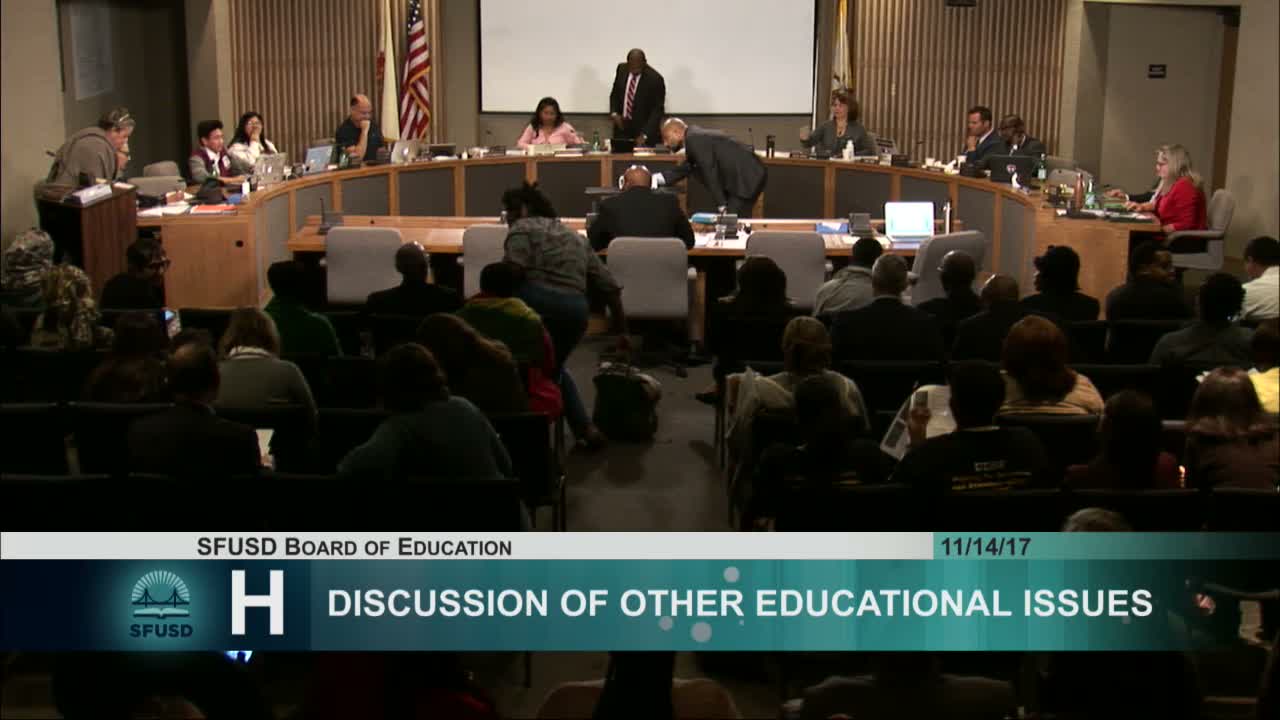
Superintendent Vincent Matthews outlined a 90‑day assessment and initial plan on Nov. 14, telling the San Francisco Unified School District board he had visited dozens of sites and met with parents, educators, students and civic leaders. Matthews said the district’s overall performance masks deep and persistent within‑school and between‑school gaps — the largest of which affect African American students — and proposed a targeted strategy focused on roughly 20 schools that together serve a large share of the district’s African American K–8 population.
Matthews described two cadres of schools that together account for nearly half of African American K–8 students: historically underserved schools (characterized by racial concentration, high poverty and high teacher turnover) and “high‑equity‑gap” schools (strong overall performance but large disparities between racial groups). He proposed a five‑part approach drawn from school‑improvement research — professional capacity, instructional guidance, transforming mindsets, collaborative culture and high‑quality staff (summarized under the acronym "PITCH") — and said the district would develop a detailed growth plan for the focus schools to present to the community in January and begin implementation thereafter.
Public comment that followed was extensive and emotional: community leaders (including NAACP leaders and faith leaders), parents, charity and nonprofit representatives, teachers and students urged immediate action. Speaker after speaker requested concrete commitments: culturally‑competent mental‑health services, accountable evaluation of programs serving Black students, and targeted funding and staffing to reduce chronic absenteeism, low proficiency and high suspension rates. Several speakers and organizations called for a formal declaration of a "state of emergency" for African American student outcomes.
Board members responded with sustained commentary. Several commissioners praised Matthews’ listening tour and data‑driven framing; they called for central allocation of resources (rather than forcing individual schools to reallocate limited budgets), commitments to retain experienced teachers, and collaboration with city agencies and philanthropy. Vice President Mendoza McDonald, Commissioner Haney and others publicly supported declaring a state of emergency; President Walton declared it in the meeting and asked the superintendent to proceed with an actionable response plan and continued community engagement.
Next steps described at the meeting include preparation of a detailed growth plan by January, public presentations in January and February, and a phased rollout of targeted supports beginning in February. Matthews emphasized the need for resources, noted plans to seek district and external funding and said his office would return with implementation details.
Representative quotes from the meeting: "We can, whenever and wherever we choose, successfully teach all children whose schooling is of interest to us," Matthews said, quoting education scholar Ron Edmonds. NAACP President Amos Brown urged immediate action and proposed a set of accountability measures.
Why it matters: Commissioners and community leaders framed the decision as requiring cross‑sector support (city government, philanthropy, unions and community organizations). The declaration of a state of emergency signals elevated board attention and sets political expectations for rapid follow‑up and measurable outcomes.