Get Full Government Meeting Transcripts, Videos, & Alerts Forever!
Get email alerts on the Seismic Safety topic
No spam. Unsubscribe anytime.
DBI schedules CAPS start and citywide soft‑story survey to map risky wood‑frame buildings
Summary
The Building Inspection Commission heard DBI set Feb. 15 as the start of the Community Action Plan for Seismic Safety and scheduled a citywide soft‑story building survey for Feb. 24 to identify wood‑frame buildings that may need retrofit; staff outlined data filters, owner outreach and possible funding pathways.
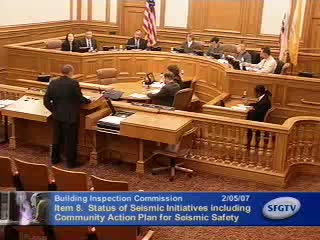
The San Francisco Building Inspection Commission on Feb. 5 was told the Department of Building Inspection will launch the Community Action Plan for Seismic Safety (CAPS) on Feb. 15 and run a citywide soft‑story building survey on Feb. 24 to collect baseline data for retrofit planning.
"February 15 is the start date," Ray Lilly, DBI manager for structural safety and emergency management, said as he described the CAPS timeline and volunteer survey plan. He told commissioners the survey will be conducted by volunteers from SEANC and EERI, plus student chapters from Berkeley, Stanford and San Francisco State.
The survey is the first step in narrowing an initial inventory of buildings. Lilly said DBI will target exterior verification of wood‑frame buildings three stories or taller and with five or more units, then cross‑check permit and retrofit records to remove structures that already meet retrofit standards. "Once I have that good data, I'm gonna go back and find out when those buildings were built, if they had permits for retrofitting," Lilly said.
Commissioners pressed staff on how the survey will avoid false positives — for example, buildings with a large street‑level opening that nonetheless have substantial interior shear walls or steel framing. Lilly said the survey is designed to filter an initial large inventory (he cited initial counts in the thousands) down using a sequence of checks — exterior verification, build year (pre‑1973), and permit searches — before owner outreach.
After the filtered inventory is produced, DBI plans to contact owners and give them an opportunity to show evidence of prior retrofits. The department described two models under consideration: an inventory plus owner‑submitted engineering reports (modeled after Berkeley) and a later, more prescriptive approach tied to code or ordinance depending on CAPS recommendations.
The commission also discussed funding options. The director reported a positive meeting with the Office of Emergency Services director and said DBI will pursue UASI and Super‑UASI grant opportunities to reimburse or support CAPS and related work. Public commenters urged rapid deployment of the survey and cautioned that retrofit programs should consider accessibility impacts and simplify loan conditions so funds (for example, UMB loan funds) are actually used.
Next steps spelled out to the commission included the Feb. 24 volunteer survey, subsequent database filtering and owner notification, and a plan to bring CAPS findings and recommended code or policy changes back to the commission and, if needed, to the Board of Supervisors for policy action.