Get Full Government Meeting Transcripts, Videos, & Alerts Forever!
Get email alerts on the Budget topic
No spam. Unsubscribe anytime.
DBI proposes conservative FY 20072008 budget, cites code change and one-time capital costs
Summary
The Department of Building Inspection proposed a conservative FY 20072008 budget that trims projected revenues to about $45.3 million amid a slowdown in large projects, earmarks one-time capital and IT costs, and allocates funds for extensive staff training tied to adoption of new building codes.
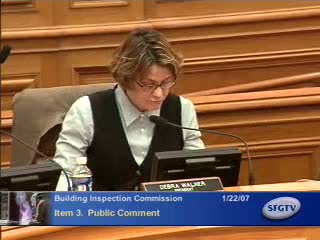
The Department of Building Inspection (DBI) presented its proposed budget for fiscal year 20072008 at the Building Inspection Commissionspecial meeting on Jan. 22, with acting director Amy Lee and Chief Administrative Officer Tyrus Madison outlining revenue shortfalls, one-time capital needs and training plans.
"This is the first hearing," Amy Lee told commissioners, noting the budget must be presented twice before submission to the mayor's office. Lee warned that in January the city's enforcement will move from the current UBC to the International Residential Code and the International Building Code, "and significant training is required for our staff." The department proposed using one-time funds for training and technology upgrades to limit ongoing expense growth.
Madison said DBI is a special fund department that relies on permit fees and that projected revenues for next year have been reduced "because we are assuming a reduction in large scale projects." He told the commission the department is projecting about $45.3 million in total revenues, down from earlier projections near $50 million, largely because some major projects that drove prior-year revenue (for example Rincon Hill and Spear, mentioned in staff discussion) are not expected to generate similarly large permit valuations in the coming year.
The proposed expenditures include priorities Madison described as technology improvements, expanded community outreach and structural-safety enhancements. Staff flagged a set of one-time, project-driven costs tied to a planned PTIS initiative, a street-address mapping program, and costs associated with relocating planning staff and renovating floors in DBI's offices. Madison said those projects are the main drivers of the year-to-year budget decline.
Madison also said the department has budgeted five new positions: a plumbing inspector, an electrical inspector, a permit coordinator, a management assistant and a structural engineer for the structural-safety division. He described premium pay increases as largely the result of recently completed MOUs and certification-related differentials for inspectors and engineers.
On the department's financial cushion, Madison said, "we have about $7,000,000 in our fund balance account. We assume that we will use $3,000,000 of those $7,000,000" if needed to balance the budget; staff emphasized that many of the identified increases are one-time costs that could be scaled back in future years if revenues remain weak.
Commissioners pressed staff for additional detail: they asked for a clearer listing of work orders and payments to other departments, the basis for revenue projections (staff said projections use a mix of current-year receipts, a 10-year seasonal average and lists of projects provided by the planning department), the timing and deliverables for the PTIS project, and whether federal/state grant sources (FEMA, UASI, homeland security) or strong-motion funds could be used to shift costs off the operating budget. DBI staff committed to follow up with work-order data and to report back at the next hearing.
What happens next: Commissioners agreed staff will return with updated work-order information and refined project cost estimates after meetings with DTIS and DPW; the budget will receive a second hearing before final submission to the mayor and board.