Get Full Government Meeting Transcripts, Videos, & Alerts Forever!
Get email alerts on the Information Technology topic
No spam. Unsubscribe anytime.
DBI pauses permit-tracking RFP, works with DTIS to cut costs and speed rollout
Summary
The Building Inspection Commission heard that DBI will rewrite its permit-tracking RFP and partner with the city's DTIS unit to avoid costly, long vendor proposals; officials cited an original street-address mapping (SAMs) budget of about $800,000 versus vendor bids above $2 million and said a reissued RFP could go out in February.
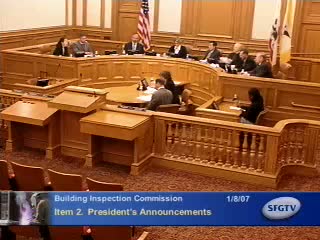
The Building Inspection Commission on Jan. 8 2007 heard that the Department of Building Inspection (DBI) is rewriting its permit-tracking request for proposals and collaborating with the Department of Technology and Information Services (DTIS) to reduce cost and delivery time.
DBI's director told commissioners the department has deployed nearly 200 new desktop computers and flat screens and has the application-version upgrade about 40% complete, but work on permit-tracking stalled after vendor bids proved much higher than anticipated. "Several times the cost came out extremely high; our initial budget for SAMs was $800,000, and we were getting bids upwards to $2,000,000 plus," the director said, explaining why DBI paused the prior procurement.
Why it matters: Permit-tracking and address-validation systems are core to DBI's ability to process plans and schedule inspections. A costly, heavily customized vendor solution could extend timelines and lock the city into expensive maintenance.
DBI said it will separate business-process reengineering from technical components, prioritize the top business-process issues, and reissue a narrower RFP in hopes of delivering improvements sooner and at lower cost. The director said DBI has been talking with DTIS and other city offices including the assessor and recorder to treat street addressing as a citywide function rather than a DBI-only project. "Working with DTIS, we do have a new plan which will actually probably assist us in realizing some business-process improvements as well as actual permit-tracking systems improvements, within a shorter time frame than we anticipated," the director said.
Commissioners discussed trade-offs between off-the-shelf packages and custom systems. One commissioner warned that a cheap off-the-shelf solution can require substantial customization that increases long-term cost. DBI said it expects to reissue the RFP in February, receive responses in March and to see some meaningful system changes within roughly 12— to 18 months after contracting.
DBI also said it will likely hire a senior project manager to coordinate the procurement and integration work and that DTIS has recommended candidates and could take a stronger coordinating role for citywide GIS and street-address functions.
Next steps: DBI plans to provide a more detailed report at a future meeting and may invite DTIS to present. The commission agreed to receive further updates when the rewritten RFP is ready.