Get Full Government Meeting Transcripts, Videos, & Alerts Forever!
Get email alerts on the Special Education Staffing topic
No spam. Unsubscribe anytime.
Teachers, parents and union speakers press SFUSD board over special-education staffing cuts and demand bigger raises
Summary
Dozens of teachers, paraprofessionals, parents and union leaders packed the San Francisco Unified School District meeting to oppose cuts that reduce full-time resource specialist positions to part-time, warn of IEP noncompliance, and press the district for larger raises and alternatives to consolidations.
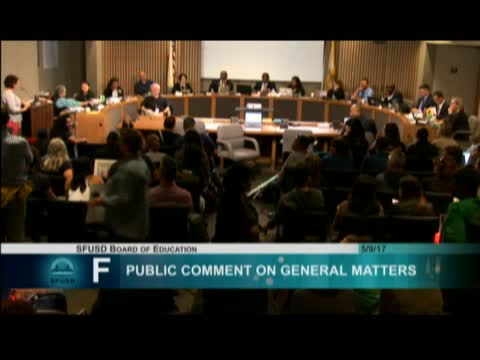
Dozens of teachers, parents and union representatives told the San Francisco Unified School District Board of Education on May 9 that planned cuts to special-education staffing and consolidations of paraprofessionals will harm students and force experienced staff out of the city.
"My name is Fiona O'Shea," said a Sanchez Elementary parent during the public-comment period, "and I want to talk about the cuts to full time resource specialist teachers to half time positions." She said Sanchez's older son had an IEP and benefited from full-time RSP attention and that shifting that position to part time would make it “impossible for those students to be supported.”
Teachers, paraprofessionals and union leaders described a pattern of reductions across many sites. Tara Ramos, a teacher-librarian at Sanchez, said district officials relied on caseload arithmetic instead of visiting sites to judge impact. "No one visited our site to study what the impact of this cut would be on students," she said, and urged the board to examine work done on the ground.
Union speakers echoed the concerns. United Educators of San Francisco (UESF) political director Ken Trey told the board that members who have long worked in the district are being driven out by housing costs and low pay, and that smaller raises risk accelerating turnover. "Appreciation is welcome," he said, "but appreciation needs to be accompanied by a wage increase that will allow our teachers and paras to stay in our classrooms." Other union leaders asked the board to negotiate higher pay to stem immediate departures.
Multiple members of the special-education community warned of legal and service gaps if caseloads rise. A Community Advisory Committee for Special Education representative said more than 7,000 SFUSD students have IEPs and that the majority spend the day in general education classrooms, meaning general-education teachers will need supports if dedicated positions shrink. Speakers cited individual examples of caseloads and staffing ratios at risk of noncompliance, including specific claims that some schools would lose paraprofessionals and see RSP minutes cut so severely the district could not meet students' IEP minutes.
Several frontline staff described personal impacts. A special-education teacher said the program at his school previously expected a fourth special-education teacher but the position was reconsolidated; another para described the emotional and instructional consequences for a stable group of eight students with severe autism who will not receive the same consistent adult support if personnel are reassigned.
Speakers repeatedly asked the board to prioritize classroom support over central-office cuts, to restore paras and RSP allocations where frontline evidence shows need, and to negotiate a more substantial pay increase. Protesters in the room and many public-commenters urged an 18% or larger raise for teachers and support staff; one speaker called for a 25% increase to keep staff in the city.
Board members thanked speakers and indicated the testimony would be part of ongoing budget and labor discussions. The meeting later proceeded to a series of policy votes and reports, while the public-comments record remained a prominent expression of community concern about special-education resources and retention.
The meeting record shows no formal action at this session reversing the staffing decisions; public commenters said appeals and school-site processes would continue. Several speakers left written materials and data with staff for follow-up.