Get Full Government Meeting Transcripts, Videos, & Alerts Forever!
Get email alerts on the Grand Jury Response topic
No spam. Unsubscribe anytime.
SF Building Inspection Commission debates response to grand jury follow-up, weighing oversight and staff morale
Summary
Commissioners discussed a draft response to the 2003 Civil Grand Jury follow-up report, citing progress on hardware, barcoding and training while weighing the grand jury's calls for random secondary field inspections and a statement of incompatible activities. Staff pledged further analysis and a draft response for the commission to review.
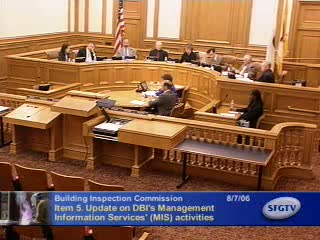
The San Francisco Building Inspection Commission spent a large portion of its Aug. 7 meeting considering how to respond to a Civil Grand Jury follow-up report from 2003 that identified 16 recommendations and flagged several items needing further attention. President Walker read portions of the report into the record and noted staff has implemented steps including computer upgrades, training programs and plans for a barcode system to track permits and plans.
Acting Director Amy Lee told the commission the department has made "substantial progress" on several recommendations but that some items require more analysis. She said the department has issued a staff code of conduct and is working with the city attorney and the Ethics Commission on a citywide template for a statement of incompatible activities. Lee said the Ethics Commission has provided multiple templates and is underfunded, and that DBI may need to refine a department-specific version while coordinating with citywide policy.
A central point of debate was the grand jury's recommendation to conduct random secondary field inspections as a quality-control measure. Lee said senior staff have historically performed spot checks and proposed pairing senior inspectors with newer inspectors for mentoring and targeted spot checks rather than continuous shadowing. "We were told to have some sort of quality control measure," Lee said, framing the proposed checks as a way to verify inspection quality and inform training.
Carla Johnson, acting deputy director, said the practical value of following inspectors in the field is limited and emphasized reviewing paperwork and day-to-day documentation as an effective alternative. Some commissioners expressed concern that unannounced secondary inspections could demoralize field staff, while others argued oversight is needed to address inconsistent practice or favoritism identified by the grand jury.
On ethics, the commission discussed whether to adopt a department-specific statement or wait for a standardized city template. Commissioner Grubb urged clearer citywide direction so departments do not operate under inconsistent rules; Lee said she has discussed options with the mayor's office and would seek to coordinate implementation while pursuing DBI's own clarifications where necessary.
Director Lee said staff will prepare a draft response reflecting the commission's input and noted some recommendations will require additional analysis before a final response is filed. The commission agreed to continue the discussion and include the department's input as part of the response process.
The meeting record shows the department's next steps will include refining training and quality-control practices, coordinating with the Ethics Commission and returning a draft response for commission review.