Get Full Government Meeting Transcripts, Videos, & Alerts Forever!
Get email alerts on the Education Policy Pe topic
No spam. Unsubscribe anytime.
Board splits contentious PE/JROTC resolution after hours of debate; issues of credentialing and funding remain
Summary
After lengthy public testimony from hundreds of JROTC students and supporters and extended debate over credentialing, equity and central funding, the SFUSD Board voted 6-1 to divide a combined PE/JROTC resolution into two separate motions for further work.
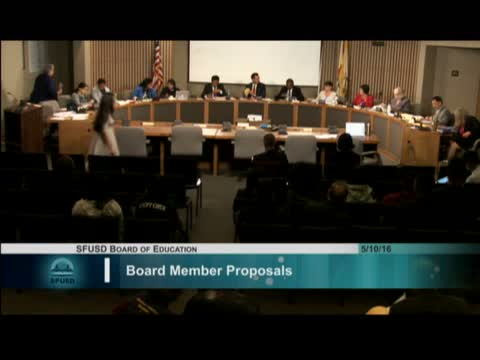
The boarddeliberated for more than two hours May 10 on a broad resolution intended to revise SFUSDphysical education (PE) policy and clarify when programs such as JROTC can earn PE credit.
Authors summarized the proposal as an effort to align board policy with recent state guidance and to eliminate conflicting provisions. The draft would rescind older PE exemption language, incorporate AB language (as cited in the draft as "AB 13 91"), and explicitly permit JROTC students to receive PE credit if instructors hold a specified credential, or in alternative arrangements such as independent study supervised by appropriately credentialed staff.
Public comment proved decisive in shaping the conversation. More than two dozen JROTC cadets and alumni described leadership, improved GPAs and the programsocial supports they derive from the unit. Cadet speakers and community supporters urged the board to allow PE credit to reduce scheduling burdens and paperwork for students who already perform rigorous physical training.
Board members pressed district staff on two linked issues: credentials and funding. Staff and legal counsel explained three routes for awarding PE credit for JROTC: (1) a JROTC instructor who obtains the new PE/JROTC credential; (2) a fully PE-credentialed teacher supervising the course; or (3) continued use of an independent-study option with additional supervision. Budget staff clarified that under some assumptions—if existing JROTC instructors obtain the new credential—an $189,000 supervisory cost for independent study would be avoided, lowering the memo's estimated fiscal impact from about $467,000 to roughly $278,000.
Several commissioners said they supported clarifying PE policy and relieving practical burdens for students, but many expressed concern about diverting central discretionary funds to a federal program (JROTC) while other high-need schools and programs face staffing and safety gaps. Vice President Walton and others argued the federal government should be the primary funder of JROTC; others said denying credit is unfair to students.
Given the depth of disagreement, Commissioner Winns proposed—and the board voted—to split the single resolution into two separate actions: (A) the JROTC-specific pieces (credentialing and PE-credit mechanics) and (B) the broader PE policy/exemptions changes. The board agreed to return both items as separate motions and to identify the appropriate committee path for review. The roll-call vote to divide the resolution was recorded as: Feuer Aye; Mendoza McDonald Aye; Marazzi Aye; Norton Aye; Walton No; Winns Aye; Haney Aye (6-1).
Board leadership and staff said they will work with authors to draft two clean documents and bring them back to the full board, with the superintendent suggesting the PE policy portion become a superintendent proposal to allow a thorough policy review. No final policy change was adopted that night: the division was strictly procedural; the substantive questions about credentialing timelines, fiscal responsibility and equity will be revisited in follow-up sessions.
Votes at a glance: motion to divide the PE/JROTC resolution — passed 6-1; approval of parent involvement policy amendments for Hillcrest and Francisco Middle — passed (7 ayes); consent calendar items approved as recorded.
What happens next: staff and authors will split the language into two separate proposals, refine fiscal and credentialing details, and return the items for board consideration after committee review or as superintendent proposals where appropriate.