Get Full Government Meeting Transcripts, Videos, & Alerts Forever!
Get email alerts on the Arts Education topic
No spam. Unsubscribe anytime.
SFUSD advisory committee urges deep refresh of 10-year arts education master plan
Summary
An advisory committee recommended a substantial refresh of San Francisco Unified School Districtarts education master plan to strengthen K-12 sequencing, equity and accountability and proposed a centralized arts center to expand access and professional development.
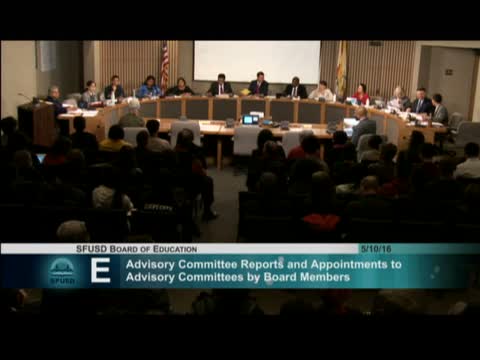
President Haney and Superintendent Carranza convened the Board of Education May 10 to hear a 10th-anniversary review of the districtarts education master plan and a recommendation from the Arts Education Master Plan Advisory Committee to pursue a significant refresh rather than a light edit.
Brent Stevens, SFUSD chief academic officer, told the board the original plan helped expand arts offerings but that the districtnow faces new policy and instructional contexts — including common core, the Every Student Succeeds Act and recent local ballot measures — that make a deeper review timely. "We are much closer than we were 10 years ago," Stevens said, but added the committee sees gaps in sequencing, integration and equitable access across schools.
Judy Nemzoff and Frances Phillips, co-chairs of the advisory committee, described how the working groups organized around administrative leadership, professional development and curriculum/evaluation to inventory accomplishments and surface persistent gaps. The administrative group credited the district with establishing an Arts Coordinators Network and hiring Visual and Performing Arts supervisors and teachers on special assignment, but recommended clearer expectations for principals, inclusion of arts goals in the LCAP and strategies for creative scheduling so students progress sequentially.
Speakers representing curricula and instruction said elementary access has broadened, but secondary sequencing remains inconsistent because of site-based planning and competing A-G and multilingual requirements. The evaluation group recommended adding arts indicators to the districtbalance scorecard and developing common evaluation vocabulary and tools so the district can measure quality and system change rather than just counting programs.
Supporters on the panel pushed the concept of a district arts center to provide rehearsal and exhibition space, centralized equipment, professional development labs and a pipeline to arts careers. "This center could be a pipeline to provide college and career opportunities," said Sherry Young of the African American Shakespeare Company, outlining rehearsal, costume and media labs, and suggested transportation to the site for distant schools.
Students who participated in the advisory process emphasized access and accountability. Cyrus Quan, a student co-chair, urged that district planning tools (weighted student formula, LCAP, PEAF) be aligned to guarantee access, benchmarks and reporting in accountability documents.
Board members praised the presentation while pressing for implementation clarity. Commissioner Norton asked how a refresh would differ from another plan document; Stevens said the committee would return to the board with a plan to engage the community and a likely timeline to complete a refresh within the next school year, while committing near-term staffing steps such as hiring a secondary arts supervisor.
Several board members asked for concrete sequencing or "blueprints" similar to those used by New York City; others pressed for assurances that a new plan would not become another unimplemented booklet. The advisory committee and district staff emphasized that the refresh would build on the work of the past decade and include community engagement and measurable accountability.
The board heard public comment from educators and advocates who called for ensuring implementation and improving communication with families (including non-English materials). The presentation concluded with a district pledge to return with a clear engagement plan and specified next steps for committee and staff work.
The board did not take final action on the plan at the meeting; the advisory group will return with engagement timelines, proposed benchmarks, and recommendations for how the arts center concept could be folded into district capital and program planning.