Get Full Government Meeting Transcripts, Videos, & Alerts Forever!
Get email alerts on the Student Health topic
No spam. Unsubscribe anytime.
SFUSD board adopts policy to allow counseling-linked condom access at middle-school wellness centers
Summary
After extensive public testimony for and against, the SFUSD board adopted a policy authorizing condoms to be made available through school nurses and wellness centers for middle-school students after counseling by trained staff; the vote was 7–0.
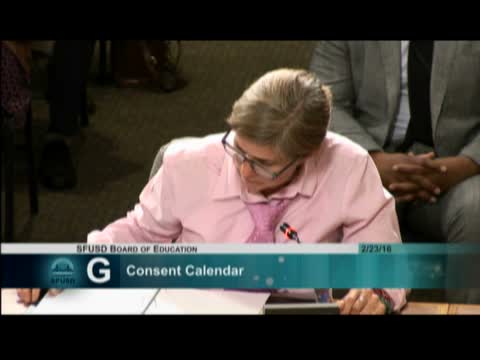
The San Francisco Unified School District board voted unanimously on Feb. 16 to adopt Board Policy 5141.25, a change authorizing condom availability at school wellness centers, including at middle schools, but only after a private counseling interaction with a trained nurse or social worker.
The proposal prompted a large and emotional public-comment period. Many parents — especially from immigrant communities — opposed offering condoms to younger students and said parents should always be informed. Speakers raised concerns about cultural appropriateness, parental consent and the timing of the district’s community outreach on the item.
Public-health voices, youth-service organizations and several educators defended the change. Dr. Susan Phillip, director of disease prevention and control at the San Francisco Department of Public Health, summarized local STD trends and said adolescents face disproportionate STD risks; she urged that counseling and condom availability reduce harm. Youth advocates and nurses described counseling-first protocols that would be used in schools.
District staff and several board members stressed the policy is not an indiscriminate giveaway: students seeking condoms would meet with a nurse or social worker for counseling about abstinence, STI prevention and family communication, and staff would encourage parental involvement where possible. The superintendent’s office clarified that condoms are provided at no cost by the Department of Public Health, not by district funds.
Board debate emphasized the need for culturally competent outreach to non-English-speaking communities and stronger parent engagement; several members committed to more translated materials and community meetings.
Following discussion, the board approved the policy by roll call (7 ayes). Staff said implementation will include training, annual notification to families about the program’s existence, and evaluation of impacts.