Get Full Government Meeting Transcripts, Videos, & Alerts Forever!
Get email alerts on the Education Math Sequence topic
No spam. Unsubscribe anytime.
Hundreds weigh in on SFUSD's new math sequence as students and parents clash over equity and acceleration
Summary
Dozens of students, parents and community groups urged and challenged a proposed SFUSD math sequence that would delay Algebra I for some students. Supporters said the change advances equity and differentiation; critics warned it would remove acceleration pathways and called for targeted supports and summer programs.
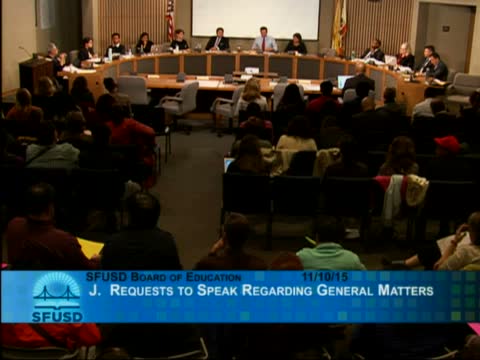
Students, parents and community groups filled the San Francisco Unified School District boardroom on Nov. 10 to challenge and defend a proposed new math sequence that shifts Algebra I away from eighth grade and keeps students in a single pathway through eighth grade.
Students from Lowell High School and parents who favor retention of eighth-grade Algebra described personal consequences of the change. "Being able to take Algebra in eighth grade allows me to be able to take AP Calculus," said Marcel Brown, a Lowell senior, arguing that earlier access opened doors to advanced coursework. Virginia Hernandez Vanzant, a Lowell senior, told the board that the choices she had previously "allowed me to design an education program that is just right for me."
Other speakers, including representatives of APAC and Parents for Public Schools, defended the district's plan as an equity measure. Marisha Robinson of APAC said the new sequence "will level the playing field and allow a more equitable framework" by preventing in-class tracking and broadening access to high-quality instruction. Miranda Martin of Parents for Public Schools urged the board to treat the meeting as an opportunity to listen and to craft communication and engagement plans with families.
The Coalition for Advocacy of Reform of Education (CARE) and other critics urged the board to preserve acceleration options for high-achieving students and to provide concrete supports for students who will need extra help to meet new benchmarks. Victor Seto, CARE president, said the policy risks leaving "qualified students receiving inferior education later on" and asked the board to "support those who deserve the fast track by letting them loose." Speakers asked for targeted summer programs, tutoring, and explicit STEM pathway options that would begin earlier for students who are ready.
Superintendent Carranza answered several concerns from the dais, saying the district has engaged the community for years and that the new Common Core-aligned course will not close the path to calculus: "You will be able to get to calculus," he said, urging speakers to focus on the district's actual curriculum design. Carranza pointed to early SBAC results and district-led outreach and said the math class being discussed includes algebraic, geometric and statistical content, rather than the older, single-subject Algebra I course.
Board members asked staff to continue monitoring rollout and data, and several asked for additional detail on supports — including summer interventions, AVID Excel pilots and partnerships with community-based organizations — so accelerated students and struggling students alike would have clear options.
The board did not take formal action on the math sequence at this meeting; members said they would continue engagement and return with more implementation detail and monitoring plans.