Get Full Government Meeting Transcripts, Videos, & Alerts Forever!
Get email alerts on the Education Assessment topic
No spam. Unsubscribe anytime.
SFUSD outlines Common Core algebra validation plan and credits surge in school breakfast participation
Summary
Superintendent Richard Carranza told the board SFUSD administered a CCSS Algebra 1 validation exam to about 700 incoming ninth‑graders and described a multi‑layered scoring and validation process; he also announced districtwide breakfast participation rose from about 9% to nearly 90% and celebrated the district's millionth breakfast.
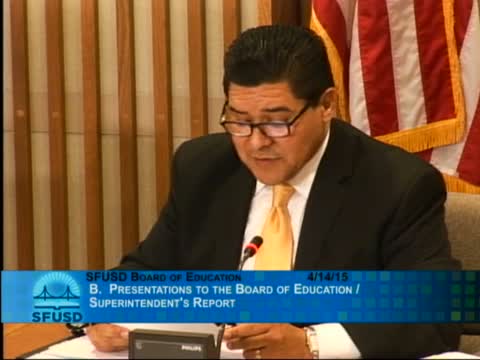
Superintendent Richard Carranza told the San Francisco Unified School District Board of Education on April 15 that the district administered a Common Core State Standards Algebra 1 validation exam on April 11 to roughly 700 students who will be ninth graders in fall 2015. The three‑site administration at Balboa, Galileo and George Washington high schools began with student check‑in at 8 a.m. and testing at 9 a.m., Carranza said, and most students took two to three hours to complete a seven‑item, open‑ended exam that requires written work and justification.
Carranza said scoring will take place in early May. San Jose State subject‑matter experts will perform double scoring under a rubric developed for the items; discrepancies will be reviewed by the authors of the CCSS mathematics standards, and a 5% random sample will be validated by external experts from the Silicon Valley Math Initiative, Lawrence Hall of Science and the University of California Office of the President. "All test items on this exam will be released to the public in the fall," Carranza said, and a second administration is planned in August for students who missed the April date or enroll over the summer.
The superintendent framed the assessment as part of a broader accountability push tied to implementation of the Common Core. He announced three district targets for the end of the 2018 school year: reduce by 50% the number of students needing to retake Algebra 1, Geometry or Algebra 2 compared with June 2013; increase the number of students who take and pass fourth‑year (post–Algebra 2) math courses by 10 percentage points; and raise the number of African American and Latino students who take and pass Advanced Placement math courses by 20 percent.
Carranza also provided an update on school nutrition. He said the district has dramatically increased participation in breakfast programs by changing delivery—allowing breakfast in classrooms and other adjustments—and "this morning I was privileged to be a guest at Balboa High School, where the 1 millionth breakfast was served." He noted participation climbed from roughly 9% to "approaching 90%" districtwide and credited teachers, food service staff and school teams for the change. "We wanted to make sure families feel secure that their students are being fairly assessed and properly placed," Carranza said of both assessment and nutrition work.
The board heard the presentation at the start of its meeting and followed with questions and praise from members who said the assessment transparency and the nutrition effort addressed parent concerns.