Get Full Government Meeting Transcripts, Videos, & Alerts Forever!
Get email alerts on the Math Curriculum topic
No spam. Unsubscribe anytime.
Parents, teachers and students clash over eighth‑grade algebra and tracking at SFUSD meeting
Summary
More than two dozen public speakers debated whether SFUSD should restore an accelerated '3‑into‑2' algebra pathway for middle school; supporters cited parity with neighboring districts and petitions, while teachers and researchers warned of tracking and urged heterogeneous, deep Common Core instruction. The board scheduled a curriculum committee review and staff presentation.
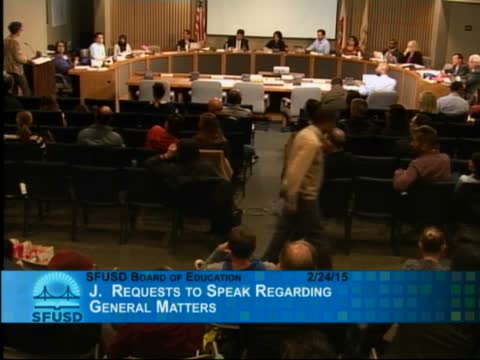
Public comment dominated the Feb. 17 board meeting as parents, teachers and students debated whether the district should restore an accelerated eighth‑grade algebra option or keep the Common Core single‑sequence strategy.
Annette Hurst, speaking for more than 580 parents who signed a petition, urged the board to consider a ‘‘3 into 2’’ option that moves select Algebra I content into seventh and eighth grades, arguing it is compatible with Common Core standards and used across Bay Area districts. “Why are we alone holding them back?” Hurst asked, listing neighborhoods and families she said support restoring an algebra option in middle school.
Several parents and community members echoed that argument, saying access to early algebra opens pathways to calculus and STEM courses in high school and college. John Monson presented comparative data he collected suggesting honors schools scored higher on historical metrics and argued the honors model was producing different outcomes for economically disadvantaged students.
Teachers and several education researchers pushed back. Taika Shue, Mission High School math department chair, said there is little evidence that acceleration produces long‑term learning gains and warned accelerated curricula can trade depth for breadth. Burton High teachers Leah Goldberg and Robert Pablo described site experiences where heterogeneous groupings and deeper Common Core instruction supported broader learning and reduced demographic clustering in advanced courses.
The board acknowledged sharply held views on both sides and announced a curriculum committee meeting with a staff presentation on the Common Core math sequence to follow (curriculum committee scheduled Monday at 6 p.m.). Board members encouraged parents to attend and asked staff to provide in‑classroom observations and further data to clarify how sequence changes would affect instruction and equity.
The board did not take a final vote on course progression that night; the public comment and the scheduled curriculum committee review will inform any future formal action.