Get Full Government Meeting Transcripts, Videos, & Alerts Forever!
Get email alerts on the School Policing topic
No spam. Unsubscribe anytime.
SFUSD and SFPD report shows fewer school arrests but persistent racial disparities
Summary
Associate Superintendent Kevin Truitt and SFPD Lt. Colleen Fattoo presented MOU-related data showing a multi-year drop in school arrests but continued disproportionate arrests of African American and Latino students; speakers and public commenters urged better site-level data, disposition tracking and a restorative-practices task force.
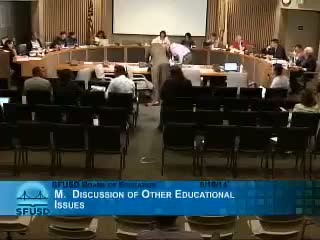
District and police officials presented the first end-of-year report under the updated memorandum of understanding, telling the School Board that school arrests have declined over four years but that significant racial disparities persist.
Associate Superintendent Kevin Truitt summarized the MOU's purpose: improve safety while avoiding unnecessary criminalization of students and strengthen alternatives to arrest. He said the MOU originally required monthly reporting; the amended schedule calls for three reports per year. Truitt acknowledged operational data gaps that limit oversight, including the board's earlier instruction not to publish school-level arrest calls and inconsistent entries in the district's incident system (Synergy) versus CARC (Community Assessment and Referral Center) records.
Lieutenant Colleen Fattoo of the San Francisco Police Department walked through the numbers and disposition categories reported by CARC: arrests, citations, CARC referrals and bookings. Officials reported that arrests fell from roughly 195 in 2010—11 to the low hundreds by 2013—14; most arrests involved allegations of physical injury or possession of weapons. Truitt and Fattoo said that many CARC referrals reflect case management alternatives rather than incarceration.
Public commenters and community advocates welcomed the lower arrest numbers but pressed the board for more transparency. Kevin Bogus of Coleman Advocates said the lack of site-level disaggregation hampered accountability: "When I look and I see that the only students who are being arrested are African American or students with Spanish surnames, that makes me feel like we haven't made a lot of progress," he said. Public Counsel's Laura Fair urged the task force to analyze outcomes and provide age-disaggregated data so the board can target supports to affected students.
Board members asked staff and SFPD to clarify call categories, disposition outcomes and how to log incidents more consistently in Synergy. Several commissioners urged that school staff receive clearer guidance on when to call police and that the restorative practices task force begin meeting in the fall to review grievances, training needs and patterns that underlie disproportionality. Truitt said the district will convene the restorative practices task force with youth representation at the start of the next school year and will work to reconcile CARC and Synergy records and increase reporting on dispositions and ages.
Speakers also raised training and communication needs between stations and schools to replicate successful local models (Lincoln High School and its Terrebonne station partnership were cited as a positive example). The board directed staff to pursue clearer disaggregation of call types, improved Synergy logging practices and follow-up analysis on dispositions and CARC case-management outcomes.