Get Full Government Meeting Transcripts, Videos, & Alerts Forever!
Get email alerts on the Graduation Requirements topic
No spam. Unsubscribe anytime.
SFUSD delays A–G implementation for continuation schools for two years
Summary
The Board of Education voted unanimously to delay A–G college‑prep implementation at continuation high schools for the classes of 2014 and 2015 and approved an amendment replacing the term 'option' with 'plan.' Staff said the pause will allow time to build supports and track students who need access to A–G coursework.
The San Francisco Unified School District Board of Education voted unanimously to approve a substitute motion that delays implementation of the A–G college‑preparatory course sequence for students enrolled in continuation high schools for the classes of 2014 and 2015.
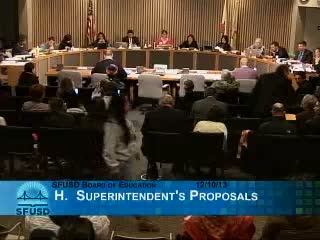
Executive Director Bill Sanderson read the requested action to the board: "the Board of Education of [SFUSD] approve and support the actions necessary to implement the recommendations of the superintendent to adopt an additional plan of study for students enrolled in court county programs, delay implementation of the A to G course sequence for continuation schools for the class of 2014 and 2015, and further clarify language aligned with AB 167 for foster [youth]." The board considered the superintendent’s substitute motion after a Committee of the Whole review and public comment.
Why it matters: A–G is the University of California and California State University sequence of courses commonly used to determine college eligibility. Board members and advocates said the temporary delay gives the district time to build the staff, courses and budget needed to make the A–G sequence widely available at continuation sites without denying a diploma to students who would otherwise be unable to complete the sequence this year.
The board also approved an amendment that replaces the word "option" with "plan" throughout the policy, a change commissioners said would reduce confusion for students and families. The amendment passed unanimously.
Community groups and legal advocates urged the board to ensure the delay is temporary and paired with clear outreach and access. "We're glad that this is not a permanent change," said Christina Canaveral of Coleman Advocates, who urged the district to use the two years to develop a fiscal plan and supports. Laura Farr of Public Counsel, which represents students in continuation schools, asked that the district make sure students and families are notified about what coursework will and will not be available during the pause and that pathways to earn A–G before age 18 remain accessible.
Staff told the board the district will begin tracking which plan students are using in the new student information system and will report data annually. Sanderson said a Dec. 3 data rerun suggested "potentially 30 students could be impacted" at continuation sites but that number could be smaller if supports enable more students to meet the requirements.
Board members emphasized that the district’s long‑term goal remains restoring a single, district‑wide A–G expectation and that the two‑year window is intended only to prevent students from losing a diploma because of prior budget cuts. The motion directs staff to monitor implementation, track student plans and return with relevant reports.
The substitute motion, as amended, passed in a roll‑call vote recorded by the clerk.