Get Full Government Meeting Transcripts, Videos, & Alerts Forever!
Get email alerts on the Local Hire Policy topic
No spam. Unsubscribe anytime.
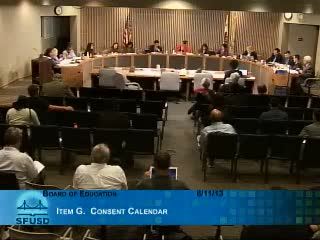
San Francisco school board adopts local-hire policy for $531 million bond, adds 10% veteran hiring goal
Summary
After extensive public comment and debate over trade coverage and sanction language, the San Francisco Board of Education unanimously adopted a substitute local-hire policy governing 2011 Proposition A projects, including a new stated goal of 10% veteran worker participation and apprenticeship-focused off-ramps.
The San Francisco Unified School District Board of Education on June 11 adopted a revised local-hire policy for projects funded by the $531,000,000 2011 Proposition A facilities bond, aiming to direct more construction work to city residents and expand apprenticeship opportunities.
The measure, offered as a substitute motion and passed unanimously, requires that projects subject to a Board-approved project labor agreement meet local-hire participation goals and creates clearer off-ramps tied to apprenticeship commitments for contractors who cannot hire qualified San Francisco residents. The board also added a stated goal that at least 10% of worker participation be filled by U.S. veterans.
The vote followed nearly three hours of public testimony. Community speakers, labor leaders and parent advocates urged a strong policy without carve-outs. ‘‘If you carve out anything, that means you are carving out something for people who have been eating at the bin for a long time,’’ said Robert Woods of the Black Leadership Human Rights Council, pressing the board to commit the full bond to local hiring. Atuma Belfry, speaking as a parent and electrician, told trustees, “It is important that whatever is passed, that we ensure that that pipeline is not only filled, but its sustainable.”
Labor stakeholders said a policy tied to a project labor agreement can include minority and small contractors. Michael Theriault of the San Francisco Building and Construction Trades Council said PLAs do not exclude minority contractors and asked the board to avoid carve-outs that would exempt projects from the policy.
Board debate focused on how to balance administrative feasibility with inclusion. Staff recommended initially applying targets to seven major trades that historically account for about 70% to 75% of labor hours on district projects, arguing that prequalification and monitoring of all 28 trades would create a heavy administrative burden and the risk of chronic noncompliance for small, short-duration subtrades.
Commissioner Haney pressed to make the standard "by trade" (covering all trades) rather than limited to seven; that amendment was put to a roll-call vote and failed. The board then accepted language that preserves staffs initial trade-target approach while adding safeguards and expansion authority if implementation shows it is feasible to include more trades in future.
Vice President Feuer proposed an amendment to the policys remedial language that links an off-ramp waiver to the contractors written outreach efforts and to sponsorship of an SFUSD or CityBuild apprentice on the district job; staff and some board members asked for more detail on how apprenticeship requirements would be implemented so they would not require contractors to retain unneeded workers merely to meet quotas. The board adopted a compromise that permits specified off-ramps only after demonstration of outreach and certain apprenticeship or internship commitments.
Vice President Feuers amendment adding a stated 10% goal for U.S. veteran worker participation passed unanimously. Staff clarified the record: the percentage is a stated outreach goal, not a mandatory exclusionary threshold.
The policy as adopted requires the superintendent and staff to implement prequalification, monitoring and reporting processes and allows the Board to revisit and expand the list of covered trades after an initial implementation period.
What happens next: staff will draft implementing procedures and monitoring systems, and the Board signaled an intent to review results and consider expanding trade coverage within months if the program meets enrollment and compliance expectations.
Speakers quoted in this article are drawn from the public record and the meeting transcript.