Get Full Government Meeting Transcripts, Videos, & Alerts Forever!
Get email alerts on the Local Budget topic
No spam. Unsubscribe anytime.
SFUSD board adopts FY2013–14 budget after extended public hearing and discussion
Summary
The San Francisco Unified School District Board approved the district’s FY2013–14 budgets after hours of presentations, public testimony and commissioner questions about where new LCFF dollars will go, rainy‑day reserves, and staffing. The vote was unanimous (7–0).
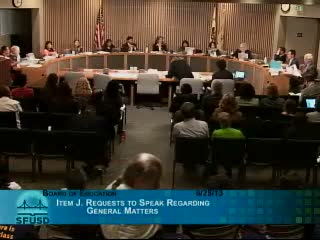
The San Francisco Unified School District Board of Education voted unanimously to adopt the district’s FY2013–14 budgets after a lengthy public hearing and staff presentation on June 25.
Superintendent Carranza opened the discussion by framing the budget as part of the district’s multi‑year effort to align spending with strategic goals, saying the adopted plan “represents a culmination of the exciting work that has been accomplished by our staff, our students, our parents, our community, and most certainly this board.” Deputy Superintendent Lee and budget staff then walked commissioners and the public through projections tied to the Local Control Funding Formula (LCFF), multi‑year revenue scenarios and cost pressures such as employer retirement contribution increases.
The budget presentation said the district expects a meaningful LCFF revenue increase next year and highlighted two large near‑term cost drivers: restoration of furlough days and step‑and‑column increases for certificated staff, and higher employer pension contributions for classified staff. Deputy Superintendent Lee told commissioners the district was planning to spend about $6.5 million of an approximately $10.5 million two‑year Common Core implementation allocation in 2013–14, primarily for professional development and curriculum work.
Public testimony ahead of the vote focused heavily on classified employees and bargaining. Several classified staff and SEIU representatives urged the district to include pay increases for classified employees in bargaining and questioned whether the adopted budget properly reflects their pay needs after years without raises. “We have not received an increase since December 2007,” said Josh Davidson, who identified himself as a school nutrition worker; he noted rising local costs and said many members earn about $30,000 per year.
Commissioners pressed staff for clearer, itemized explanations of where the roughly $20 million of additional LCFF‑era unrestricted revenue was being directed. Commissioner Winns and others asked staff to provide explicit variance analyses in future budget documents so the public can see which revenues and expenditures changed and why. Staff directed commissioners to exhibit materials and a Q&A packet for line‑by‑line variance details and agreed to provide further fall revisions and follow‑up presentations.
The board took roll call and approved the SACS (state) budget forms by a 7–0 vote.
What happens next: staff will provide revised allocations in the fall once enrollment and coding are finalized; commissioners asked for more accessible variance explanations for the public and for follow‑up on classified bargaining and site‑level allocations.
Sources: Board presentations and discussion; public testimony; roll‑call vote recorded by the board.