Get Full Government Meeting Transcripts, Videos, & Alerts Forever!
Get email alerts on the Local Hire Policy topic
No spam. Unsubscribe anytime.
Citizens bond oversight committee urges economic and legal review before SFUSD adopts Prop A local-hire policy
Summary
At first reading of a proposed local-hire rule tied to the 2011 Prop A facilities bond, the Citizens Bond Oversight Committee asked the board for independent economic and legal analyses, warning of potential monitoring costs, reduced competition and legal risk under Proposition 39.
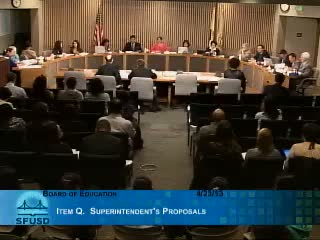
At a first reading of a proposed local-hire policy for projects funded by the 2011 Proposition A facilities bond, Jim Quadra, chair of the Citizens Bond Oversight Committee, told the San Francisco Unified School District board the committee unanimously requested two independent studies: one economic and one legal.
Quadra said the CBOCwas acting within its oversight role under Proposition 39 and that its request did not reflect a policy position for or against local hire. "The Committee passed a resolution requesting that the District commission an independent third party economist to assess how a local hire policy would impact both project and administrative costs and 2, that the CBOC receive an independent third party legal opinion," Quadra said.
At the board meeting and during a Committee of the Whole referral, a CBOC economist outlined five possible cost drivers: an estimated fixed monitoring cost (cited by the committee as $300,000 per year), reduced bidder competition, increased compliance costs likely passed through to the district, uncertainty about local labor supply and potential litigation costs if contractors challenged strict enforcement. "We've identified 5 major economic drivers that could potentially increase project costs," the committee representative said.
Superintendent Carranza acknowledged the committee's concerns and the board referred the matter to the Committee of the Whole for a more detailed policy discussion and for staff to coordinate next steps. A board member suggested the committeeshould present the composition and expertise of its membership, which Quadra provided in brief.
Why it matters: Bond funds are restricted by voter-approved language; if implementing a local-hire requirement raises project costs or conflicts with ballot language, taxpayers could see less work completed for the same bond authorizations or face legal challenges that slow projects. The CBOC asked for explicit analyses so the board can weigh economic trade-offs alongside community benefits such as local job creation.
Whathappens next: The board referred this first-reading item to the Committee of the Whole and scheduled further public discussion; the CBOC said it would expect the district to commission independent economic and legal opinions before adoption.