Get Full Government Meeting Transcripts, Videos, & Alerts Forever!
Get email alerts on the Immigration Support topic
No spam. Unsubscribe anytime.
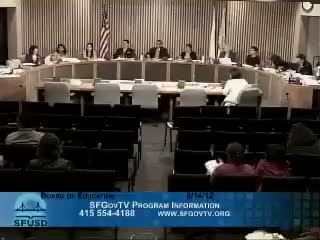
Students and community urge SFUSD to help eligible youth apply for deferred action
Summary
Students and community members testified about the June 15, 2012 deferred-action announcement, described eligibility criteria and costs, and asked the district to publicize information, translate materials and host community legal clinics to help eligible undocumented youth.
Multiple students and community advocates addressed the board during the public-comment period to describe how the Department of Homeland Securitys June 15, 2012 deferred-action announcement (DACA) could affect undocumented youth and to request district support.
Andrea Torres (introducing herself as a graduate of Mission High School) urged the district to support eligible students who could obtain work authorization and be protected from deportation for two years under DACA. Charles Sanchez, a member of ASPIRE (Asian Students Promoting Immigrant Rights Through Education), summarized eligibility requirements and application logistics, saying applicants generally must have arrived before age 16, have continuously resided in the U.S. for five years preceding the June 15 memo, be in or have graduated from school (or be an honorably discharged veteran), meet criminal-history standards, and be born on or after June 16, 1981. He noted the standard application fee is $465 and recommended legal consultation or free clinics when available.
Student speakers described personal impacts: a speaker identified as Mei said her family became undocumented late in high school and praised deferred action for easing the prospect of immediate deportation and enabling future employment. Speakers asked the district to take specific steps: distribute information through school newsletters and websites, translate materials into major local languages (including Spanish, Chinese, Tagalog and Vietnamese), host community forums with volunteer lawyers to provide case-specific advice, and ensure that individual families can obtain help with forms and evidence-gathering (birth certificates, school transcripts, medical records, letters of recommendation).
Board and staff response: The superintendent and board members acknowledged the testimonies. The public requested district assistance with outreach and translation; the speakers emphasized these were community-led, unpaid efforts and asked the district to provide logistical and informational support.
What happens next: Speakers announced local free clinics and planned community forums on Sept. 7 and Sept. 8 at Mission High School to help eligible students and families.