Get Full Government Meeting Transcripts, Videos, & Alerts Forever!
Get email alerts on the School Transportation topic
No spam. Unsubscribe anytime.
SFUSD staff outline accelerated cuts to general-education bus service; special-ed transport preserved
Summary
Deputy Superintendent Myong Li told the Board the district is accelerating a planned multiyear reduction of yellow-bus routes from 44 to 25 buses, currently serving roughly 2,779 riders, to reduce general-fund contributions; students with IEP transportation needs will not be affected, staff said.
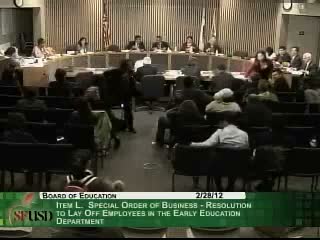
District staff told the Board of Education on Feb. 28 that general-education yellow-bus service will be pared more quickly than previously planned to reduce pressure on the general fund.
Deputy Superintendent Myong Li said the district already reduced service this school year (38 buses serving about 2,779 riders, down from 44 buses and 3,658 riders the prior year) and recommended accelerating the phase-down to a fleet of 25 buses next year to realize about $1.8 million in annual savings. ‘‘Students with IEPs that require transportation will not be impacted,’’ Li said, underlining the district’s commitment to preserving special-education routes.
Staff said the transportation changes are consistent with a board policy adopted in December 2010 and with a three-year implementation plan developed from community input and budget constraints. The policy prioritizes maintaining access to choice schools for students from the lowest-performing census tracts, preserving middle-school feeder patterns, and providing limited after-school service where feasible.
Timeline and outreach: Staff plans to finalize route- and stop-level information in the next two weeks, then produce multilingual outreach materials and collect family feedback mid-March through April. Final routes and a request-for-service process would follow in April–May. The district noted it lacks continuous, bus-ride verification technology and currently relies on periodic snapshot counts; staff said it will provide board members with per-route rider counts.
Alternatives and coordination: The presentation listed non-bus alternatives to help families adjust — expanded walking routes, walking-school-bus programs, family biking, and neighborhood ‘‘school pool’’ coordination — and said the district is coordinating with city transit/transportation planning and community partners. Several board members requested a thorough breakdown of riders per stop and urged targeted, in-person outreach in communities where electronic notices and flyers have low uptake.
Next steps: Staff will complete an impact vetting analysis, finalize materials for family engagement in mid-March, and continue coordination with principal and community stakeholders. The board did not take a final vote on route eliminations at this meeting.