Get Full Government Meeting Transcripts, Videos, & Alerts Forever!
Get email alerts on the Community Advocacy topic
No spam. Unsubscribe anytime.
Parents and students press SFUSD to restore summer school, credit recovery and parent-engagement staff
Summary
Community speakers urged the board to find funds for summer and Saturday school, credit recovery and expanded parent engagement; commissioners and staff agreed to a post‑adoption review and placed several items on a 'parking lot' for possible restoration.
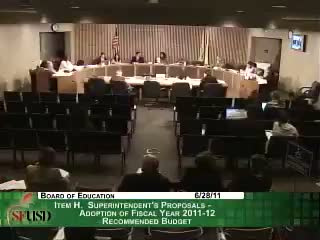
Scores of parents, students and advocates used the public-comment period to press the San Francisco Unified School District Board of Education to restore reduced summer-school and credit‑recovery services and to increase parent-engagement staffing.
What speakers asked for: Community advocates, including Coleman Advocates, requested the board prioritize money for programs they said directly affect graduation and A–G completion: examples cited in public comment included $600,000 for summer-school programs dedicated to ninth- and tenth-graders who failed A–G courses, $400,000 to expand the Office of Family and School Partnership, and an additional $1 million suggested by other speakers for Saturday and summer programming aimed at credit recovery.
Student testimony: Multiple students described struggles passing courses and asked for access to alternative or accelerated credit-recovery options that would allow them to stay on track for graduation. One student described her experience of failing multiple classes and appealed for "a second chance" and practical supports.
Board and staff response: Commissioners widely acknowledged the importance of summer and credit‑recovery programming; some members said targeted programs (for example, ninth-grade recovery) had proven effective and were cost‑efficient in previous years. Deputy Superintendent Lee and other staff described a process to park suggested restorations and vet them for feasibility if revenue improves after the state budget is final. Several commissioners requested staff to prepare specific cost and implementation proposals for consideration in the weeks ahead.
Why it matters: Board members and community groups agreed that summer and credit-recovery services are a major lever for reducing dropout risk and supporting A–G completion. Given state and local budget uncertainty, advocates urged the board to identify offsets or one-time funding sources (city partnerships, rainy-day/reserve transfers, or reallocated central funds) rather than deferring action.
Next steps: Staff and several commissioners agreed to keep a prioritized 'parking lot' of items that could be restored if the district's fiscal position improves; staff also offered to prepare a clearer mapping of which cuts the Tier 3 transfers and other budget moves are intended to avoid.