Get Full Government Meeting Transcripts, Videos, & Alerts Forever!
Get email alerts on the Tiebreakers topic
No spam. Unsubscribe anytime.
SFUSD commissioners split over whether CTIP or feeder tiebreaker should come first
Summary
Commissioners, staff and community groups debated whether to prioritize CTIP (an equity preference) or a feeder tiebreaker during a multi‑year transition; simulations with limited data showed minimal differences, and commissioners asked staff for more CTIP demographic and placement data before final action.
San Francisco Unified School District commissioners spent substantial time Monday debating the order of tiebreakers used to assign students to middle schools during a multi‑year transition.
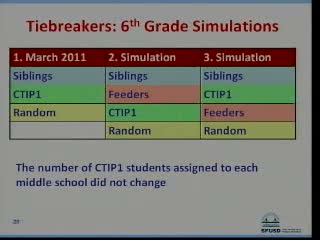
Staff said the superintendent recommends using sibling → feeder → CTIP during the transition years to encourage the development of K–8 feeder patterns through family choice. ‘‘We—re recommending that we place the middle school feeder tiebreaker above CTIP…because it supports changing enrollment patterns that facilitate the development of K–8 feeders through a choice process,’’ the presenter said.
The presenter also shared simulations based on limited data that showed switching the CTIP and feeder order produced very small absolute changes in placements because CTIP‑eligible students make up a relatively small share of applicants. Commissioners cautioned that the simulations are weak evidence because families did not list feeder patterns as a choice in prior rounds; several said the board should prioritize stated equity values and asked staff to provide further demographic and placement data on CTIP students before the board takes final action.
Ruth Grabowski, speaking for the Parent Advisory Council, urged the board to ‘‘prioritize students equitable access to opportunity’’ and to place CTIP (or another equity mechanism) ahead of feeder tiebreakers so families who cannot travel far are not disadvantaged.
Commissioners were divided: some — citing uncertainty about CTIP’s impacts and the possibility of unintended consequences — favored keeping the superintendent’s recommendation; others said the board should emphasize equity by putting CTIP higher. Staff committed to provide more data on CTIP applicants and outcomes and noted monitoring procedures will be in place to track effects and allow adjustments during the transition period.
Parents in public comment described the practical effects of assignments. Olga Milan Howells, an Alvarado parent and treasurer of Upper Noe Neighbors, asked that the Alvarado attendance area match the traditional Noe Valley boundary at Sturgis Street and cited local kindergarten request numbers. Another parent, Chaddy Cotter, described a placement across town and said the experience left her feeling disadvantaged.
The ad hoc committee did not take a formal vote on the tiebreaker order at the meeting; commissioners asked staff to return with additional CTIP demographic and placement data and to finalize monitoring questions by August.