Get Full Government Meeting Transcripts, Videos, & Alerts Forever!
Get email alerts on the Public Comment topic
No spam. Unsubscribe anytime.
Parents urge SFUSD to address unplaced students, transportation and equity in K–8 feeder plan
Summary
At the committee meeting parents and PAC/PPS representatives urged caution: many incoming sixth-graders remain unplaced, transportation burdens and equity trade-offs need clear plans, and PAC/PPS asked staff to prioritize equity in tiebreaker order and produce implementation details before board adoption.
Parents, the Parent Advisory Council (PAC) and Parents for Public Schools (PPS) used the committee meeting to press the district for operational detail before adopting feeder infrastructure.
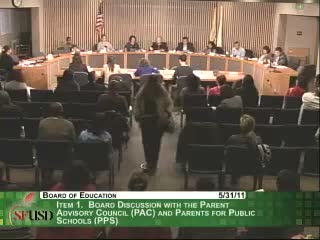
PAC and PPS presenters (Ellie Rossiter, Yoon Yoon and Nancy Gaffzin Ganass) opened the public segment by asking whether the proposed feeders actually achieve the board’s stated goals — ending racial isolation, providing equitable access, and increasing transparency — and whether staff plans for transportation, special-education inclusion, staffing and finance are developed before adoption. "Are we missing something? Are you seeing some things we're not addressing?" PAC representatives asked.
Throughout public comment, parents described individual placement hardships and logistical burdens. Anne Backstad, PTA president at Lafayette, said many fifth‑grade families remain without assignments and asked that the district prioritize families who did not receive any placement in both rounds: "We are big advocates of the K-eight feeder pattern," she said, but requested the district accommodate unplaced children before school begins. Other parents recounted long transit times and double transfers on Muni, worrying that distant assignments would force families to seek private or charter alternatives. Community members also asked whether expansion of language pathways could be funded without dismantling existing arts and electives at schools such as Aptos and Presidio.
PAC urged adjusting the order of tiebreakers to elevate equity mechanisms (CTIP or other measures) over feeder priority so that families in lower-performing attendance areas would not be locked into underperforming middle schools. Staff replied that some changes (removal of density tiebreaker, application-form adjustments) are administrative, and that feeders are intended to be implemented via choice with a feeder tiebreaker before it becomes an initial offer in 2017.
Board members acknowledged the depth of parent concern and asked staff to return with more specific plans and analyses — including seat‑count modeling and clear timelines for transportation, special-education placement, and budget implications. The committee did not adopt the policy at this meeting and agreed to forward it to the full board without recommendation so staff can supply the requested materials before a vote.
Ending: The full board will consider staff materials and the committee’s feedback at an upcoming meeting; parents asked for prioritization of unplaced families and transparent designation procedures prior to the start of the school year.