Get Full Government Meeting Transcripts, Videos, & Alerts Forever!
Get email alerts on the Student Assignment topic
No spam. Unsubscribe anytime.
SFUSD staff recommends phased K–8 feeder plan, delays full implementation to 2017
Summary
District staff proposed a phased K–8 feeder infrastructure to support middle-school quality, adjust tiebreakers in the choice system, and delay full implementation until 2017 so current elementary students are not displaced; board members requested further analysis and the committee forwarded the item without recommendation.
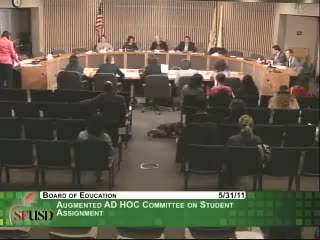
District staff on Tuesday presented a proposal to the San Francisco Unified School District board to create a K–8 feeder infrastructure intended to support more predictable enrollments, better articulation between elementary and middle schools, and improved middle-school quality.
The staff presentation, introduced by Arla and developed with a multi-department team, said the feeder model would align with the board’s student-assignment goals (policy P5-101) — including reducing racial isolation, improving transparency and predictability, and using facilities and transportation more efficiently. Staff cited demographic maps and simulations showing a projected 33% increase in middle-school enrollment and argued K–8 feeders would narrow disparities in incoming achievement across middle schools and allow targeted, cost-effective program planning.
Staff proposed administrative changes to the existing choice process rather than eliminating choice: maintain a choice system but add a feeder tiebreaker that favors students who attend the elementary school that feeds to a given middle school; keep sibling preference; and retain other equity-related tiebreakers in modified order. The presentation also recommended removing a density tiebreaker the district found ineffective, and adding an option on the application form so parents requesting language programs can be designated to the closest language pathway with openings.
On timing, staff proposed a phased approach that delays full K–8 implementation to 2017 so students currently enrolled in elementary schools would not be impacted. Staff said the tie-breaker changes would begin sooner (fall 2012–fall 2016 window) and that by roughly 02/2017 initial offers would be made on the basis of elementary enrollment for cohorts entering sixth grade.
Staff emphasized the proposal is intended to be one tool among others — including investments in middle-school programs, language pathways and special-education redesign — and said many of those efforts will continue whether or not feeders are adopted. Arla told the committee staff will incorporate board feedback and return for a second reading. Deputy Superintendent Richard Carranza was named to walk the committee through next steps.
Committee members asked staff for additional analyses before the board’s planned June 14 vote, including seat-count modeling that shows how the proposed tiebreaker order would change who receives offers and how current CTIP (low-test-area) preferences would interact with feeders in practice. After extended discussion the committee declined to forward a recommendation and instead voted to send the proposal to the full board without recommendation.
Next steps: the full board is expected to consider the item at a later meeting (staff cited a June timeline), staff will provide the requested modeling and clarifications, and community engagement will continue as staff refines implementation details.