Get Full Government Meeting Transcripts, Videos, & Alerts Forever!
Get email alerts on the After School topic
No spam. Unsubscribe anytime.
District and community partners outline after‑school expansion and coordination needs
Summary
District staff and community partners described efforts to coordinate after‑school services citywide, citing approximately 13,000 youth served across ~90 schools with about $11 million in ExCEL funding; parents and the PAC urged more access, clearer fee proposals and transportation planning as the district faces possible state budget cuts.
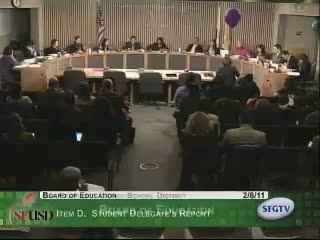
Community leaders, district officials and parent representatives used the Feb. 11 board meeting to press for clearer planning on after‑school capacity, funding alignment and transportation as the San Francisco Unified School District prepares for possible state budget cuts.
Michelle Jacques Menegas, speaking for the Parent Advisory Council, said PAC priorities include expanding access to high‑quality after‑school programs and aligning public funding streams (Excel, child development programs, DCYF) to strengthen program quality. "We look forward to our continued work with the district, staff, and After School for All advisory council to ensure the success of these efforts," she said.
A public commenter raised a consent‑calendar item for Playworks (a playground/structured‑recess program) listed at $10,000 and questioned whether that dollar amount matched the program scope. The commenter argued that the services resembled certificated work and asked the board to scrutinize contracting decisions before automatic approval.
Associate Superintendent Kevin Truitt introduced three partnership groups. Vivian Scott, chair of the San Francisco Out‑of‑School Time Coalition, said the coalition’s members—roughly 30 agencies—serve about 13,000 youth annually at over 90 schools, applying approximately $11,000,000 in ExCEL funds to programming that includes arts, sports and academic support. "We are really dedicated to working alongside you," Scott said, urging the district to make the coalition a consistent partner in policy design and program quality work.
Sandra Naughton of the Department of Children, Youth, and Families said the After School for All council seeks to increase access by leveraging public and private funding and to raise program quality through common tools such as a quality self‑assessment and core competencies for after‑school staff. Jamie Harrison of New Day for Learning described efforts to develop partnership practices, shared tools, and frameworks to evaluate alignment between school priorities and community‑based providers, particularly in sites supported by School Improvement Grants (SIG).
Commissioners focused questions on transportation for off‑site programs, program sustainability and potential sliding‑scale parent fees, and how different funding rules (Title‑5 child development vs. ExCEL) should be aligned locally. Partners described a mix of fee models in practice—some programs have introduced modest sliding scales with increased parent engagement—and urged creation of shared data on waiting lists and capacity so the district can target scarce resources.
The district said it will continue to coordinate community meetings, publicize a waiting‑list and program database (sfkids.org), and integrate after‑school program assessment into school planning processes to better match services to site needs.
Next steps: district staff will share the quality‑assessment tools with principals and CBO partners, gather waiting‑list data, and continue community outreach about proposed changes to after‑school transportation and program alignment.