Get Full Government Meeting Transcripts, Videos, & Alerts Forever!
Get email alerts on the Peaf Prop H topic
No spam. Unsubscribe anytime.
Board approves Prop H spending plan after amending evaluation line to $200,000; members press for clearer impact data
Summary
The Board adopted a $29.3 million Public Education Enrichment Fund (PEAF/Prop H) spending plan but amended it to increase evaluation funding from $105,000 to $200,000 (reducing the reserve by $95,000). Commissioners pressed staff repeatedly for concise, outcome-focused reporting showing how the annual $30 million investment advances district strategic goals.
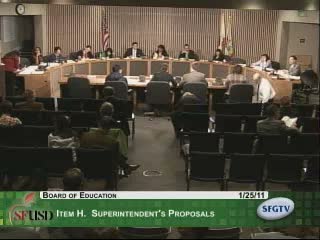
Kathy Fleming, program administrator for the Public Education Enrichment Fund (PEAF), presented the proposed 2011–12 expenditure plan on Jan. 25 and described the charter-mandated split of funds: one-third to First 5 (preschool) and two-thirds to SFUSD (SLAM—sports, libraries, arts, music—and other student-support programs). The proposal before the Board estimated a 2011–12 allocation of $29.3 million, including approximately $2.2 million of in-kind services and a reserve intended to buffer state reductions.
Board members used the discussion to press for evaluation and impact evidence. Several commissioners said they were unable to find a concise summary of program impact tied to district strategic goals (student achievement, access, equity). Walter Chang (research and evaluation) and RPA staff explained they had developed logic models and performance-measure charts and that some program areas already report outcome-oriented measures; staff said more work was needed to synthesize impact results into a board-ready, layperson-friendly report.
Associate Superintendent Chris Armentrout proposed an amendment to recharacterize a line item labeled "program evaluator" (originally $105,000) as a broader "program evaluation" budget and increase it to $200,000, funded by a $95,000 reduction from the PEAF reserve. The Board approved the amendment by roll call and later approved the PEAF spending plan as amended. At the final vote the Board recorded six "Aye" votes and one "No" (Commissioner Feuer).
Throughout the debate commissioners requested a clear timeline and deliverables for evaluation: a concise public-friendly summary that could be shown to voters, program-level outcome statements that tie spending to student outcomes, and quarterly progress reports showing carryover and how program promises are being fulfilled. Staff agreed to return in March with a more developed evaluation plan and to provide the board with copies of program-level data the district already collects.
The approved PEAF plan retains SLAM—s charter entitlement (one-third) and sets aside funds for ongoing programs, in-kind contributions, and a reduced reserve after the amendment. Board members emphasized the urgency of producing robust, accessible impact reporting before the charter—s sunset/renewal discussions with voters.