Get Full Government Meeting Transcripts, Videos, & Alerts Forever!
Get email alerts on the Prop H Peaf topic
No spam. Unsubscribe anytime.
Parents, students and advisory committee urge restoration of learning‑support staff and clearer Prop H transparency
Summary
The Public Education Enrichment Fund community advisory committee presented its annual report, urged restoration of cuts to 'third‑third' programs—including learning support professionals and violence prevention—and called for clearer, more measurable reporting on program impact ahead of Prop H reauthorization discussions.
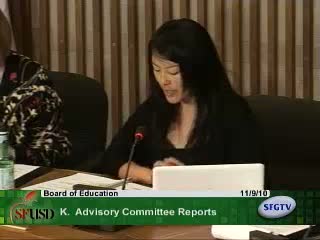
The San Francisco Unified School District's Public Education Enrichment Fund Community Advisory Committee presented its annual report at the Nov. 9 board meeting, urging the board and district staff to restore reductions to the 'third‑third' portion of Prop H funding and improve transparency about how those funds are allocated and measured.
The committee, co‑chaired by Tim Lennon and Stevon Cook, told the board that PEAF (Prop H) provides approximately $30 million annually for athletics, libraries, arts, music, wellness centers and other student programs that serve the district's roughly 55,000 students. The committee recommended restoring learning support professionals (LSPs) and avoiding further cuts to third‑third programs, saying reductions had removed a $4 million reserve and eliminated violence‑prevention programs that previously served about 10,000 students.
"The reductions to learning support professionals mean that a number of schools currently do not have social workers and school nurses," the committee said during its presentation. "We recommend restoring LSPs as much as possible so that all elementary, middle and K–8 sites have LSP support." Deshaun Smith, a student from Washington High School, described how the wellness center supported his access to medical appointments and introduced him to peer outreach work. "None of this would be possible without the wellness," Smith told the board. William Velasco, a student speaking on behalf of learning support professionals, said an LSP helped him stay in school and ultimately earn a scholarship to attend Sacred Heart Cathedral Prep.
Board members acknowledged the personal testimony and pressed for more specific data. Commissioner Feuer thanked the committee and said the board needs evaluation measures that show impact, not only counts served. "We can say so many were served, but we never really talked about the evaluation around impact," Feuer said, noting that restorative justice funding previously drawn from violence‑prevention dollars was reduced by about $300,000 this year.
Committee members and staff (including program evaluator Walter Chang) said they will provide more detailed evaluations and work with the board on clearer reporting so the community can see how money is being spent and what outcomes are expected. The CAC also said it will broaden community engagement and increase student representation on the advisory committee.
The board did not take a formal vote on funding at the meeting; several commissioners thanked the students and committee members and asked staff to return with more specific budget and program evaluation information ahead of future discussions about renewing Prop H.