Get Full Government Meeting Transcripts, Videos, & Alerts Forever!
Get email alerts on the Student Assignment topic
No spam. Unsubscribe anytime.
SFUSD unveils draft attendance boundaries, middle‑school feeder plan and transportation framework; public meetings set
Summary
School district staff proposed attendance areas for 58 of 72 elementary schools, new middle‑school feeder patterns intended to reduce racial isolation, and a strategic transportation policy; materials will appear on a public website and staff will hold community meetings Aug. 25–Sept. 1 for feedback.
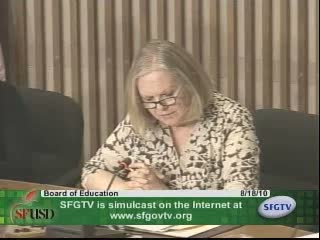
The San Francisco Unified School District on Aug. 23 presented draft elementary attendance‑area boundaries, proposed middle‑school feeder patterns and a high‑level transportation policy framework intended to increase equity and reduce racial isolation across middle schools. Staff said the materials — including maps, frequently asked questions and a new online tool — will be posted to a public website the district intends to launch the next day and that community meetings will run Aug. 25 through Sept. 1.
Ms. O'Keefe, a district staff member leading the presentation, said the superintendent's proposal would draw attendance areas around 58 of the district's 72 elementary schools while leaving 14 schools citywide or reserved for programs with special admission criteria. "So tonight's goal is to share the superintendent's recommendations for elementary attendance areas, elementary to middle school feeder patterns, and a transportation policy, and to launch a community engagement process," she said.
Jean Gobelay of Lapkoff Gobelay Demography summarized the technical approach staff used to identify areas for priority tie‑breakers: the team geocoded student addresses, pooled four years of California Standards Test English‑language arts scores (2006–2009) for more than 140,000 student records, and averaged scores across census tracts (combining tracts where necessary) to define geographic areas with the lowest average test scores. "We computed the average test scores," Gobelay said, describing the goal of targeting assignment tie‑breakers to neighborhoods with concentrated academic need.
Staff emphasized that the draft attendance areas are non‑overlapping and were drawn to respect school capacity, avoid systematic over‑ or under‑enrollment, and limit crossings of major thoroughfares where possible. The district proposes reserving a share of seats at some schools for citywide language or magnet programs; such reserved seats reduce the number of places available under attendance‑area tie‑breakers, staff noted, using Clarendon as an example where approximately half the kindergarten seats are set aside for a Japanese language program.
On feeder patterns, Gobelay said every K‑5 elementary school (including those with citywide programs) would be assigned to a middle school; K‑8 schools are not included in the feeder map. The stated goals for feeders are to "reverse the trend of racial isolation and the concentration of underserved students" and to improve academic diversity among middle schools. Gobelay told the board the current point spread between the highest and lowest middle‑school average CST/ELA scores is 81 points and that the proposed patterns would reduce that spread to around 46 points, with supporting tables available for review.
Staff also proposed a transportation policy framework intended to support the assignment goals rather than reproduce the district's existing, broadly distributed transportation network. "The transportation policy that we have is 30 years old," Ms. O'Keefe said. The draft framework calls for limited, strategic general‑education transportation from designated areas to support reasonable access to assigned elementary and middle schools; first reading of the policy framework is scheduled for Aug. 24, with a second reading and possible action in September. Staff said administrative regulations and route details would be developed over the fall and that route information would be shared before families submit applications for the 2011 school year.
To aid public review, the district will launch a website containing large, zoomable maps, feeder lists, a "discover your school options" search tool and an online survey that staff said will capture street‑level suggestions and questions for staff to aggregate. Staff urged commenters to be specific in survey responses (street names or school names) to allow staff to incorporate input into map updates.
Board members pressed staff for clarifications on capacity modeling (two surplus/deficit models were created — one that assumes current citywide program participation continues and one that treats citywide seats as unavailable), how K‑8 schools were treated in feeder projections, and verification plans to reduce address‑fraud risk. Ms. O'Keefe said the Educational Placement Center is expanding an address‑verification unit and the district is preparing more detailed notes and footnotes to accompany projection tables.
During public comment parents and advocates expressed mixed reactions: some praised the effort to create neighborhood continuity and coherent feeder cohorts, while others worried that the new system still leaves uncertainty for many families and could be gamed by address changes. Ren Volpe, a McKinley librarian and parent, told the board: "There are several schools here that are just set up for failure." A parent, Roger Wong, described his experience with the current enrollment system: "We've got 0 out of our 7 choices," he said, recounting months on waiting lists. Students First representatives urged stronger neighborhood preference and said the proposed system risks incentivizing address maneuvering.
The board and staff agreed to post more detailed capacity and projection tables, to provide translations and outreach prior to community meetings, and to continue the discussion at an ad hoc committee meeting on Sept. 13 and at a planned action session on Sept. 28. Staff also said kindergarten application forms are expected to be available Nov. 13 and the district will hold a kindergarten fair to support family decisions.
The committee concluded by scheduling follow‑ups on special‑education placement alignment and verification protocol development. The committee adjourned after confirming the community meeting schedule and the Sept. 13 follow‑up session.