Get Full Government Meeting Transcripts, Videos, & Alerts Forever!
Get email alerts on the Student Assignment Implementation topic
No spam. Unsubscribe anytime.
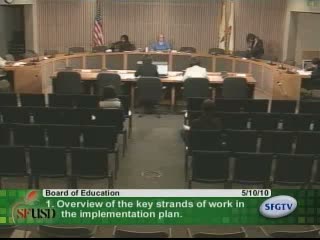
School committee reviews rollout plan for new student assignment policy, sets timeline for August and November milestones
Summary
Staff told the San Francisco Unified School District committee on May 10 that boundary maps, transportation guidance, software and outreach work will be ready for public engagement in August–September and that an enrollment fair and interactive maps are planned for Nov. 13; the committee set an August 18 ad hoc meeting date.
Staff presented a detailed implementation plan for the district’s new student assignment policy and a timetable for completing core pieces before the 2011–12 enrollment cycle.
O'Keefe, presenting a high-level PowerPoint to the committee, said staff would finalize capacity data for demographers and ‘‘by August 9, share that information with the board,’’ launching public engagement in August and September and aiming to have technical systems and materials ready by Nov. 13, the date set for an enrollment fair. ‘‘We will have our enrollment fair on November 13 and launch the new enrollment cycle for the 11, 12 school year,’’ she said.
The presentation identified four core work strands: drawing attendance boundaries, developing a transportation policy, building technical and administrative infrastructure to handle enrollment and assignments, and creating an outreach and recruitment campaign. Staff stressed that boundaries depend on capacity figures collected from schools and that capacity is not the same as current enrollment.
On boundaries and programs, O'Keefe said some schools will be ‘‘citywide’’ or have no attendance-area boundaries—examples include newcomer programs, full-immersion elementary schools, K–8s, and all high schools. She gave examples such as Alice Fung Yu and West Portal and said about 14 elementary and K–8 schools would be treated as citywide or program-reserved for the initial assignment process.
Staff said they will use multiple years of CST English language arts data to build the CTIP-style maps for 2011–12, review boundaries annually and present any recommended changes to the board in public before implementation. For middle schools, staff noted feeder patterns may be noncontiguous when necessary to maximize racial diversity, a choice that will create trade-offs with student travel distance and transportation needs.
On transportation, staff outlined guiding principles and trade-offs to be explored, including limited within-attendance-area buses to improve access, targeted strategic transportation for low-income elementary students, the possibility of eliminating middle and high school transportation, and cooperation with Muni for student access. O'Keefe emphasized these are exploratory options and ‘‘not... recommendations’’ at this stage.
For the technical platform, the district is finalizing a memorandum of understanding with teams from Duke, Stanford, MIT and Harvard to develop and monitor an open-source enrollment application and to provide documentation and monitoring tools. Staff said they are purchasing GIS tools so parents can use an online interactive map by Nov. 13 to check addresses and attendance-area preferences.
Outreach and recruitment work will be funded through a federal grant. Staff said they solicited proposals from integrated marketing firms and expect to return to the board on June 8 with a recommended vendor so campaign development can begin in mid-June.
Board members requested regular interim reports and clearer public materials. Several commissioners asked for a district map showing all citywide programs and reserved seats so the public can see where program seats might limit attendance-area priority. The committee agreed to provide monthly updates and a ‘‘parking lot’’ of unresolved issues for board and public input.
During public comment, a resident urged a systematic communications campaign, saying previous changes ‘‘lost hundreds and thousands of students’’ and calling for regular, dependable postings of maps, phone lines and visuals so families can track developments.
On scheduling, committee members discussed calendar conflicts for an August draft review; staff proposed bringing draft boundaries and a draft transportation policy on Aug. 9 for discussion. After availability concerns were raised, the committee agreed to move the August meeting to Aug. 18 to give staff and board members more time to review materials.
The committee did not take formal votes on policy changes at the May 10 meeting; staff committed to return with draft materials, interim reports and outreach plans as outlined.
The committee adjourned after confirming the revised August meeting date and next steps.