Get Full Government Meeting Transcripts, Videos, & Alerts Forever!
Get email alerts on the Peaf topic
No spam. Unsubscribe anytime.
Board approves amended PEAF spending plan, increases restorative justice funding
Summary
After debate about committee process and tier‑3 flexibility, the board adopted an amended Public Education Enrichment Fund spending plan (version B) that raises funding for restorative justice implementation to about $664,750 and reallocates some Prop H resources; the vote followed extended discussion about school‑level impacts and transparency.
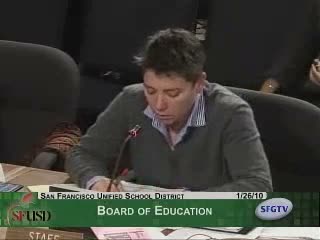
The Board of Education on Jan. 26 approved an amended Public Education Enrichment Fund (PEAF/Prop H) spending plan for 2010–11 (item 101‑12 SP2, version B) after weeks of committee review and a lengthy board discussion about priorities and budget trade‑offs.
Staff summarized the plan and noted a total PEAF allocation of $29.1 million for 2010–11, split evenly between SLAM (arts, music, libraries, PE) and general uses, with a reserve portion intended to offset state funding cuts. The board debated one notable change: raising the restorative justice program funding from an originally estimated $233,000 to $664,750 to support framework development, middle‑school phasing and coaching, plus partnerships with community‑based organizations. Associate Superintendent Trish Baskin described the funding as “the beginning of the funding to look at middle‑school phasing in of programs and services, but more importantly looking at the framework.”
Some commissioners objected that the higher figure had not been reviewed by the budget committee and urged allowing school sites the flexibility to use their portion to protect positions instead of implementing new districtwide programs. Others said restorative justice was a board priority and that full implementation would require the larger allocation. The board debated an amendment proposing flexibility for school sites; the amendment was moved and later withdrawn. After public comment from arts organizations and program managers urging support for the PEAF spending plan and a vote to adopt version B, the motion passed on roll call.
Staff noted several line‑item adjustments in the version B sheet (including reallocations for peer resources and some infrastructure), and commissioners asked that the superintendent inform the Board of Supervisors that subsequent amendments to PEAF may occur based on state funding.
Next steps: staff will finalize the PEAF spending plan documents, post them publicly and begin implementation of the restorative justice task‑force recommendations and program rollout in conjunction with community organizations and school sites.