Get Full Government Meeting Transcripts, Videos, & Alerts Forever!
Get email alerts on the Student Assignment Redesign topic
No spam. Unsubscribe anytime.
SFUSD details six-option student‑assignment redesign, launches citywide outreach
Summary
San Francisco Unified School District staff outlined six options for redesigning student assignment, announced five public town‑halls (Nov–Jan) with simultaneous translation, two Stanford‑linked studies to inform policy, and an outreach plan targeting 300 community‑based organizations and underrepresented families.
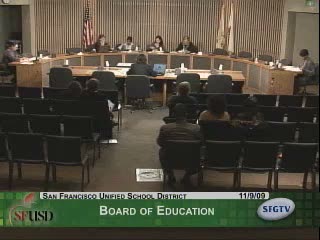
San Francisco Unified School District staff on the meeting presented a timetable and public‑engagement plan to guide a redesign of the district’s student‑assignment system, laying out six options and announcing a series of community conversations and five citywide town‑hall meetings between November and January.
Miss O'Keefe, a district staff member leading the presentation, said the board will use findings from two concurrent research efforts — a qualitative study of 24 randomly selected schools funded by the Council of the Great City Schools and the Legal Defense Fund, and a quantitative analysis by Stanford’s education team under Linda Darling Hammond — together with community feedback to draft a new student assignment policy. “We want to make sure that everyone has a deep understanding of the board’s priorities and the options the board is considering,” she said.
Why it matters: the district’s current assignment approach includes citywide programs and designated assignments; staff said about one‑third of schools currently lack attendance boundaries and the redesign could redraw boundaries, change lottery preferences and create new zone or local assignment models. The board intends to review study results and community input in public sessions: Stanford’s quantitative findings were targeted for the Dec. 14 meeting, the qualitative interviews for Jan. 25, and staff expects a first reading of a new policy in February.
The six options fall roughly into three groups: lottery‑based variations (three lotteries with different preference rules), a zone model (approximately three geographic zones with intra‑zone assignment and program balancing), and local‑assignment models (attendance‑area priority with citywide choice or broader choice where seats exist). O'Keefe emphasized the numbering of options is for discussion only and does not reflect board preference.
To gather community input, staff will: publish a translated outreach booklet (English, Spanish and Chinese), host about five large public meetings (each 6–8 p.m.), deploy roughly 30 smaller community conversations run with partners, and post raw meeting feedback and demographic capture on the web for board review. The announced town halls were Nov. 18 (Mission High), Dec. 2 (Washington High), Dec. 15 (Parkside/Diane Feinstein), Jan. 7 (Drew Elementary, Bayview) and Jan. 14 (Francisco Middle, North Beach); staff acknowledged a flyer error and said the Drew address would be corrected after a commissioner pointed it out.
Partners and logistics: staff said they will mail a hard‑copy notice to more than 300 community‑based organizations (CBOs) and invited agency partners to share the notice by email as well. Ruth Grabowski of the Parent Advisory Council and Ellie Rostor of Parents for Public Schools described plans to reach 300–400 parents through roughly 30 conversations and to prioritize outreach to families who typically do not attend board meetings. Rostor said the Zellerbach Foundation provided a grant to cover childcare and interpretation at community conversations.
Access and format: the district will provide simultaneous Spanish and Chinese translation at town halls and a multilingual facilitator team at community conversations; staff said smaller breakout groups by language will be used when sufficient participants require them. Facilitators will record demographic information and verbatim comments at meetings; town‑hall notes will be posted raw and also provided directly to the board. Board members asked for regular updates on meeting schedules and suggested weekly email digests or a shared Google Doc to track added meetings and member attendance.
Public input and next steps: commissioners praised the outreach strategy and asked staff for both raw meeting transcripts and synthesized pattern analysis to inform deliberations. O'Keefe said the board could expect the quantitative presentation in mid‑December, qualitative findings and community feedback in late January, and that staff would seek to reserve a January retreat or a Saturday session to review simulation results; a first reading of a policy is expected in February.
At the close of the short meeting, one parent during public comment asked the meaning of "CBO," and staff replied that it stands for "community‑based organization" (nonprofit). The board adjourned after thanking attendees.
The board’s next steps are the Dec. 14 meeting for the Stanford quantitative study, the Jan. 25 presentation of qualitative interviews and community feedback, and a planned first reading of a student assignment policy in February.