Get Full Government Meeting Transcripts, Videos, & Alerts Forever!
Get email alerts on the Small Schools topic
No spam. Unsubscribe anytime.
Board debates June Jordan staffing contract and small‑schools autonomy; SSE and district defend positions
Summary
Board members questioned a contract with Small Schools for Equity (SSE) funding several coordinator positions at June Jordan School for Equity; SSE leaders and school staff defended the roles as full‑time, site‑specific functions funded partly by SSE and flexible district allocations, and commissioners asked for more budget detail.
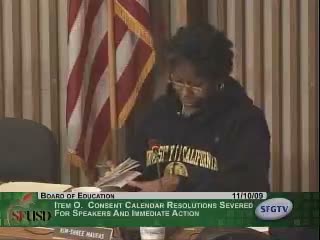
Commissioners pressed district staff and Small Schools for Equity (SSE) leaders on Nov. 2 about a resolution authorizing contract funding for several coordinator positions at June Jordan School for Equity.
UESF President Dennis Kelly asked whether the positions listed were subject to the district’s collective bargaining processes and why some responsibilities were being handled by non‑certificated or externally contracted staff. SSE Executive Director Catherine Avendano and June Jordan staff described a long-standing partnership dating to 2003 under the small‑schools model, which grants participating schools additional flexibility over a lump-sum budgeting allocation (an expanded weighted-student formula) in order to staff to a school’s particular vision. They said SSE supplements district funding with grant revenue and other external funds — citing roughly $600,000 of SSE support for June Jordan this year — and that the listed positions are site‑level coordinators that work year‑round and are full time.
June Jordan co‑director of school culture Derek Smith described school culture work — discipline protocols, parent engagement, assembly redesign, teacher professional development and attendance systems — that he said cannot be fulfilled solely by counselors or part‑time staff and requires a dedicated, on‑site role. SSE and school representatives also noted that principals are asked to offer extended‑hours stipends to teachers first and only if teachers decline are outside candidates engaged for certain coordinator roles at elementary schools.
Board members asked for a fuller breakdown of funding sources, the degree to which positions are funded by district versus SSE, and how ‘‘increased accountability’’ under the small‑schools model is enforced in practice. Several commissioners asked for the item to be returned to the budget committee with detailed staffing and funding spreadsheets.
What’s next: Commissioners requested that district and SSE staff present a budget breakdown showing all funding sources and the full‑time equivalents for each position; staff agreed to bring the requested details to the budget committee.