Get Full Government Meeting Transcripts, Videos, & Alerts Forever!
Get email alerts on the School Assignment topic
No spam. Unsubscribe anytime.
Parents, NAACP and Montessori advocates clash at SF school board over William Cobb site
Summary
At a Dec. 8 school board meeting, hours of public comments focused on a contested plan to place a public Montessori program at William Cobb Elementary. Montessori parents urged protection of seats and program fidelity; many Cobb families and NAACP leaders opposed changes they said would displace neighborhood students.
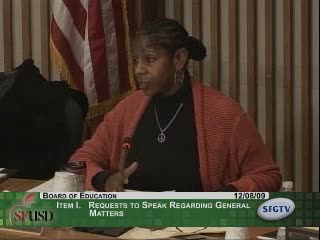
The San Francisco Board of Education spent a large portion of its Dec. 8 meeting hearing passionate public comment about the future of William Cobb Elementary School and a proposal to host a public Montessori program there.
Montessori parents told the board they want certainty and protection for children currently enrolled in the program. Sandra Herman, who identified herself as a Montessori parent, asked the board to “end this uncertainty and decide to either continue with Montessori at Cobb or find the Montessori program a new home,” saying parents had prepared information packets for board members. Yvonne Karimas, another parent, said the program had become “one of the most balanced and diverse programs in the school district” and pointed to a waitlist and high demand.
But dozens of other speakers urged the board not to displace Cobb’s established general-education program. Minya McGriff, representing the San Francisco NAACP, said the Western Addition has already lost many neighborhood schools and asked the board to “leave Cobb School alone,” calling it a landmark in the African American community. Rev. Arnold Townsend told the board the community was “afraid of what’s happening with the education for their children at William Cobb,” describing deep historical concerns about school closures in the neighborhood.
Children and parents delivered emotional appeals. Multiple young students spoke directly from the podium—“I love my school. Please don't close it,” one child said—underscoring how the debate has reached into families’ daily lives.
Board members and staff said they heard the comments and committed to additional outreach. President Malthus (presiding) said the board would organize follow-up community meetings in January and encouraged coordinations among speakers so more voices could be heard. Superintendent Garcia acknowledged the tensions and stressed the district’s commitment to inclusive planning, while also noting the district must balance program goals and legal/operational constraints.
No formal vote on site closure or relocation was taken at the meeting. Instead, the board instructed staff to continue community engagement and to report back with options and a timeline, and several commissioners asked for a tighter schedule and clearer information about program costs, consultant roles and placement logistics.
What happens next: the board signaled it will hold further public meetings and asked staff to report back with written briefs and a plan for next steps, including whether the Montessori program can be preserved in a way that addresses community equity concerns.