Get Full Government Meeting Transcripts, Videos, & Alerts Forever!
Get email alerts on the School Discipline Restorative Justice topic
No spam. Unsubscribe anytime.
San Francisco school board adopts restorative-justice framework, sets funding review and timeline
Summary
The San Francisco Unified School District board approved a substitute resolution creating a restorative-justice and school-climate framework with a task force, quarterly progress reports and a plan due by June 2010; the board added amendments requiring a funding plan and limited legal exceptions for mandated suspensions.
The San Francisco Unified School District Board of Education voted to adopt a substitute resolution on Oct. 8 creating a districtwide restorative-justice and school-climate framework meant to reduce suspensions and expulsions, increase attendance and develop alternatives grounded in restorative practice.
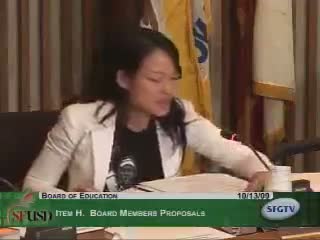
Vice President Jane Kim read the resolution’s operative language, saying the framework “reduces student suspensions, increases student attendance, and creates school climates that supports joyful learners.” The substitute motion—numbered in the agenda as Resolution 96-23 a1—directs the superintendent to develop a comprehensive plan and timeline by June 2010 and anticipates initial implementation in February 2011, with quarterly progress reports to the board.
Board members discussed and adopted several amendments before final approval. Commissioner Wins proposed language requiring that a funding plan be developed that would not increase the district’s projected 2010–11 deficit; the board directed the budget committee to examine possible redeployment of existing resources and other sources such as Prop H to support implementation. Commissioner Sandra Feuer won a changes package that kept the requirement that principals “shall” use alternatives but added the qualifying phrase “unless strictly mandated by law” to address situations such as firearm or knife incidents that state law requires to be treated differently.
The proposal prompted extensive public comment and testimony from teachers, students and community groups. Teachers’ union and classroom representatives urged clear staffing and funding details so new duties would not add uncompensated work; student speakers and youth advocates urged strong youth representation on the implementation task force and suggested restorative alternatives such as peer courts and skill-building programs.
Board members also debated how prescriptive the policy’s appendix should be. Commissioner Norton proposed labeling Appendix A as “recommended policy components” to give staff implementation flexibility; that amendment failed after roll call. The board nevertheless instructed staff to produce a written implementation plan and said the task force would advise on design, implementation and evaluation.
The resolution passed as amended (board recorded approval and an affirmative vote total recorded in the meeting as six ayes). The board’s directions call for quarterly reporting to monitor timelines and outcomes and a staff-funded implementation plan to be returned for further fiscal review.
The board’s action creates an official district structure for piloting restorative approaches in targeted middle schools and selected elementary and high schools, with continued community and student involvement required during the planning phase.