Get Full Government Meeting Transcripts, Videos, & Alerts Forever!
Get email alerts on the Assessment Results topic
No spam. Unsubscribe anytime.
SFUSD presents modest CST gains, but achievement gaps and AYP status remain
Summary
District officials showed multi‑year gains on California Standards Tests and a large jump in family survey responses, but acknowledged the district remains a Program Improvement (PI) district with persistent gaps for African American and Latino students. Staff promised school‑by‑school and subgroup data follow-ups.
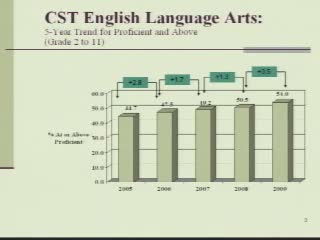
Superintendent Garcia and Dr. Ritu Khanna, the district's executive director for research, presented five‑year trends in the California Standards Test (CST) and the results of a newly expanded satisfaction survey.
Khanna told the Board the district saw overall increases in proficiency rates and student movement between bands. She reported an increase in English language arts proficiency and a 3.5 percentage‑point districtwide gain this year. In math, Khanna said proficiency (grades 2–7) reached about 62.2 percent and that participation in eighth‑grade algebra rose from roughly 40 percent five years ago to 65 percent today.
Khanna said some historically lower‑performing groups showed larger year‑to‑year gains: African American students improved by about 4 percentage points and Latino students by about 3.5 points. Still, she acknowledged gaps remain. "Even with the increases, our African American students are about 10 percentage points below state averages," she said, and the district continues to be designated a Program Improvement (PI) district because it will not meet all Adequate Yearly Progress (AYP) targets under federal rules.
Commissioners pressed for details on definitions and methodology. Commissioner (unnamed) noted that in California "proficient" is higher than the grade‑level standard used by some other states; Khanna agreed and said that California's proficiency bar has risen. Board members asked for school‑level and subgroup breakouts, return rates for the parent surveys, and cross‑analysis of algebra participation by school and race. Khanna said the district would provide school‑by‑school disaggregations and promised to run reports by race and grade to examine preparation for eighth‑grade algebra.
The presentation also covered a satisfaction survey that the district expanded this year. Khanna said staff increased family responses from roughly 1,000 in an earlier administration to 12,779 in the most recent cycle by partnering with schools to distribute and collect surveys. On the balanced‑scorecard measures, families and students rated "someone at home cares about my learning" and teacher support items highly; lower items included opportunities for community service projects and some middle/high school indicators of engagement.
Board members asked for additional analysis, including special‑education data (which the state is still holding), return rates by school, and longer trend lines for specific grades (for example, multiple years of second‑grade performance). Dr. Khanna said staff will return with the requested disaggregated data and the district's plans to address slow movement from "basic" to "proficient" for some cohorts.
The board did not take formal action on the presentation; commissioners thanked staff for the analysis and asked for follow‑up materials to be posted online and distributed to the Board.