Get Full Government Meeting Transcripts, Videos, & Alerts Forever!
Get email alerts on the Student Assignment topic
No spam. Unsubscribe anytime.
Parent groups report feedback from 270 families; urge clearer communication and program continuity
Summary
Parent Advisory Council and Parents for Public School summarized conversations with more than 270 families, recommending improvements to the enrollment guide, school communications and a four‑month community engagement timeline to inform student‑assignment models.
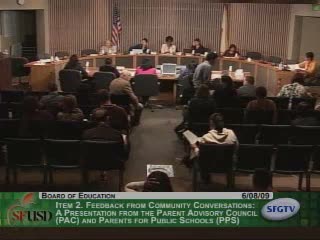
Michelle Menegas, chair of the Parent Advisory Council, told the Board that PAC and Parents for Public School convened community conversations with over 270 parents to gather perspectives on student assignment.
"Assignment itself isn't really the problem. Our problem is what's going on in the classroom," Menegas said, summarizing parents' recurring concerns about school quality, teacher training and information access.
Speakers for the parent groups said most parents support the district's equity goals but want realistic timelines, clearer communications in families' home languages and program continuity from elementary through secondary school. Patricia Pope (Parents for Public School) and Ruth Grabowski (PAC staff) emphasized that many families do not regularly attend board meetings and rely on translated, school‑based materials. "We heard from parents who said, 'I have a daughter in high school and I'm paying attention, but I don't go to meetings because most of them aren't in my language,'" a parent quoted in the report said.
PAC and PPS recommended immediate actions that do not require major new resources: add more detailed, school‑level information to the SFUSD enrollment guide (program hours, eligibility, costs and openings), use the School Times newsletter to explain policy issues and how families can engage, and post translated materials in the top five languages. They urged a four‑month timeline to plan and implement authentic community engagement around any new assignment models.
During public comment, parents raised related concerns: transportation and commute burdens for families with children in multiple schools, continuity of language programs into middle and high school, teacher hiring and retention at lower‑performing sites, and the need for clear metrics to evaluate proposed assignment scenarios. Board members thanked PAC and PPS, said they are coordinating modeling work with outside researchers and demographers, and committed to a summer analysis and fall community rollout of models.
The board did not vote on a policy change; members said further modeling and community engagement will inform any later decisions. The student‑assignment process will resume in September.