Get Full Government Meeting Transcripts, Videos, & Alerts Forever!
Get email alerts on the English Learners topic
No spam. Unsubscribe anytime.
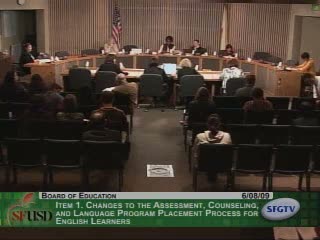
SFUSD staff propose expanded assessments, counseling and placement changes for English learners
Summary
District staff recommended interim changes for 2009–10 to assess incoming kindergarteners and immersion applicants, expand counseling, train staff and publish enrollment materials in the top five languages to create continuous K–12 language pathways.
San Francisco Unified School District staff on Tuesday presented a package of interim steps intended to improve how English learners are identified, counseled and placed into language programs.
Sherry Vaughn, supervisor of English Learner Support, said 29 percent of district students are designated English learners and that the district counts 57 home languages. "We have 15 elementary schools with Cantonese biliteracy and far fewer secondary pathways," Vaughn said, noting Cantonese and Spanish programs are concentrated at the elementary level and often do not continue into middle and high school.
Darlene Lim, executive director of the Educational Placement Center, told the board the recommendations respond to staffing reductions and changes since 2005 in how and when assessments were administered. Lim said the Educational Placement Center will resume primary‑language assessments for applicants to dual immersion programs (Spanish, Cantonese and Mandarin), and the district will conduct English‑language assessments for all incoming kindergartners who list a non‑English home language.
Staff recommended several operational steps: establish an assessment team and tools; provide assessment results and family counseling before assignment runs; expand counseling so families understand program benefits and options; train principals, counselors and teachers on program models; and publish enrollment and assessment materials in the top five languages (adding Vietnamese and Tagalog to existing translations).
Vaughn described the English Plus pathway as "a minimum of 30 minutes in elementary school or one period a day in ELD at their proficiency level," taught by CLAD‑credentialed teachers with strategies to provide access to core curriculum. Families who decline dual immersion or biliteracy placements would be assigned to English Plus so students still receive targeted support, staff said.
Lim said staff has identified potential sites for expansion and will analyze budget implications and funding sources before implementing changes. The recommendations are framed as interim steps for the 2009–10 school year while the district continues a broader redesign of the student‑assignment process.
Board members asked for a plain‑language legend of terms and for the district to publish a list of outside researchers and partners working on assignment modeling. Lim said the district is in discussion with economists and researchers, including individuals who have advised other large districts, and is planning analysis over the summer to inform fall community conversations.
The board did not take a vote on these recommendations; staff said the measures are implementation steps to be carried out by the Educational Placement Center and other departments and reported back as they develop.