Get Full Government Meeting Transcripts, Videos, & Alerts Forever!
Get email alerts on the Jrotc Pe Credit topic
No spam. Unsubscribe anytime.
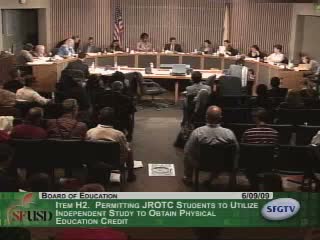
Board adopts narrow JROTC independent‑study option for PE credit after lengthy public debate
Summary
After hours of testimony for and against, the San Francisco Board of Education approved an amended resolution directing staff to create an administrative regulation allowing JROTC students to earn PE credit via independent study if programs meet district standards, with safeguards including documentation and instructor certification.
The San Francisco Board of Education voted to allow a narrow independent‑study option for JROTC students to earn high‑school physical‑education credit, after a lengthy public hearing and several amendments to tighten requirements.
The resolution as amended directs the superintendent to develop an administrative regulation that will define how students document compliance with PE standards, require a process for fitness testing administered by certificated staff, and require JROTC instructors to obtain state certification to provide general supervision before the option becomes widely available.
Supporters — including current and former JROTC students and program staff — told the board the program builds fitness, leadership and attendance. “In my freshman year I was invisible,” said Wing Yan Li, a JROTC participant who testified in favor of the change, adding the program “gave me communication skills and leadership skills.” Several student speakers argued the physical training and after‑school activities deliver more robust physical activity than their typical PE classes.
Opponents, including health professionals and public‑advocacy groups, urged the board to stick to state expectations that physical education be taught by credentialed PE teachers. “Students can only get PE credit by taking a class that fully encompasses PE standards and curriculum and is taught by a credentialed PE teacher,” Tig Risco of the National Lawyers Guild told the board. Pediatrician Dan Kelly told the board his professional association “specifically opposes a substitution of JROTC and band and other non‑PE programs for PE credits.”
Board members debated legal and logistical issues. One central point of dispute was whether the independent‑study option could meet the statutory requirement that students receive at least 400 minutes of PE every 10 school days; staff and the district PE specialist said the regulation must ensure activities meet content standards and that routine activities (changing clothes, roll call) are considered within the total minutes.
The board passed an amended set of language and the motion to request staff develop a regulation; the amendment carried in roll call as recorded in the meeting transcript (4 ayes, 3 no). The resolution requires the district to consult stakeholders and to set an implementation timeline, including instructor credential expectations. The board reserved the right to terminate the option at sites where instructor certification is not obtained.
Next steps: staff will draft the implementing administrative regulation, consult PE content specialists and stakeholders, and return to the board for review and adoption of the policy and regulation.