Get Full Government Meeting Transcripts, Videos, & Alerts Forever!
Get email alerts on the Budget topic
No spam. Unsubscribe anytime.
Board adopts 2009–10 budget; staff warns of deeper cuts ahead
Summary
The San Francisco Board of Education adopted the district’s 2009–10 recommended budget after staff outlined reliance on rainy‑day reserves and federal stimulus funds. Officials said deeper reductions are likely in later years and asked the public to prepare for a budget deliberation process in the fall and winter.
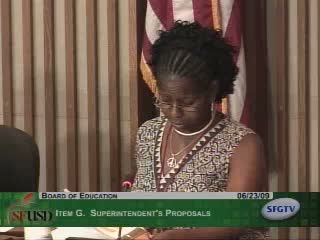
The San Francisco Board of Education voted to adopt its recommended fiscal year 2009–10 budget after a lengthy presentation and discussion about the district’s revenue outlook and likely future cuts.
Deputy Superintendent Myung Li told the board the recommended budget will end 2009–10 meeting the district’s required minimum reserves and about $3.2 million in excess of that minimum. She and budget committee members warned the board that, unless revenues improve, the district faces considerably tougher choices in subsequent years: staff said planning estimates include potential cuts on the order of about $30 million in each of the following fiscal years and urged the board to begin early, public deliberations on priorities.
The budget discussion drew sustained questioning from commissioners about specific assumptions, including the use of prior‑year attendance (ADA) for funding projections, the effect of a negative cost‑of‑living adjustment shown in the committee tables, and the district’s estimates for step/column salary costs and rising health benefit rates. Deputy Superintendent Li and budget staff said the percentages in the budget narrative were derived from standard School Services of California calculations and that staff would provide more dollarized breakdowns for board review (step and column at roughly 1% of unrestricted general fund salaries was noted as an example).
Commissioners pressed for clearer public‑facing explanations and earlier calendar timing for tough decisions—particularly on transportation service reductions that the board asked staff to study—and asked staff to report back with more granular estimates (for example, the dollar value of step/column and health‑care assumptions and a note on the ADA base being used). Staff agreed to add explanatory footnotes in electronic copies of the budget book and to convene a more intensive budget conversation early in the new fiscal year.
The board recorded a roll‑call vote and approved the recommended budget (7 ayes). Following the vote, commissioners and staff reiterated that the district’s current position benefits from rainy‑day reserves and federal stimulus dollars, but that 2010–11 and 2011–12 will require hard decisions and active community engagement.
What’s next: staff said the board will reconvene budget deliberations and that the budget committee will schedule follow‑up meetings (first interim and a focused fall/winter process) to drill into assumptions and develop options for the coming years.