Get Full Government Meeting Transcripts, Videos, & Alerts Forever!
Get email alerts on the Special Education Deaf Programs topic
No spam. Unsubscribe anytime.
SFUSD outlines expansion of deaf and hard‑of‑hearing programs, acoustical upgrades and staffing plans
Summary
District staff presented a three‑year strategic plan for deaf and hard‑of‑hearing programs (07/01/2007–02/2010), reporting program expansions, recruitment of credentialed staff, plans to hire itinerant teachers and partnerships with consultants, and facility acoustical work costing roughly $770,000 so far with total auditorium work exceeding $1,000,000.
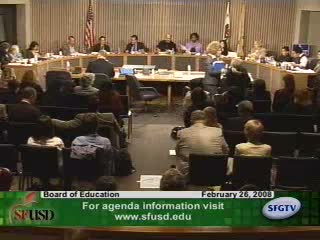
San Francisco Unified School District staff presented a three‑year strategic plan for deaf and hard‑of‑hearing programs at the Feb. 26 meeting, describing recent program additions, staffing growth and facilities upgrades.
Special Education Services and the Educational Placement Center said they had implemented six new deaf/hard‑of‑hearing program options in the past 2½ years, recruited eight additional credentialed professionals and planned further expansions through the 2008–09 school year, including additional auditory‑oral and total‑communication classrooms and more itinerant teachers of the deaf.
Facilities staff reported that acoustical modifications were completed in 37 classrooms over the last two years at a cost of approximately $770,000, and that auditorium upgrades planned for spring break would bring total acoustical spending above $1,000,000. Facilities outlined completed work at specific sites including John O’Connell High School, Aptos Middle School, Claire Lilienthal (Scott and Madison campuses), Cesar Chavez, Tule Elk and Lafayette.
Program staff said they have about 180 deaf and hard‑of‑hearing students preschool through grade 12 and described steps to identify students during enrollment (a hearing‑impaired checkbox on the enrollment form with a subsequent EPC query and review of IEPs). The district described parent‑to‑parent support meetings, weekly parent training in signed English, and plans to contract with an audiological clinic for audiological management in fall 2008.
Parents and advocates at the meeting urged clearer, measurable goals, firm timelines, and a dedicated program administrator with deaf‑education experience. One parent said the strategic plan's goals were too general and repeated language from earlier plans, and urged hiring an administrator and forming an advisory group to deliver concrete milestones. Staff responded by noting added programs and promised to provide more specific staffing and outcome reporting to the board.
Outcome: Board received the strategic plan update; staff agreed to provide additional numeric breakdowns, staffing reports and follow‑up timelines.