Get Full Government Meeting Transcripts, Videos, & Alerts Forever!
Get email alerts on the Education Programs topic
No spam. Unsubscribe anytime.
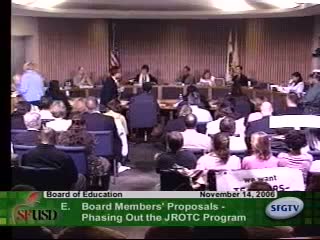
SFUSD board votes to adopt substitute resolution to phase out JROTC programs
Summary
After several hours of testimony from hundreds of students, parents and veterans, the San Francisco Board of Education on Nov. 14 adopted a substitute resolution (65‑23a1) directing a two‑year phased withdrawal of Junior Reserve Officers’ Training Corps (JROTC) and requiring staff to develop alternative, non‑military programs and PE credit guidelines.
The San Francisco Board of Education adopted a substitute resolution on Nov. 14 directing a phased removal of JROTC from district high schools and ordering staff to develop alternative pathways for physical‑education credit.
Interim Superintendent Gwen Chan opened the meeting by praising voters for approving Proposition A and State Bond 1D, then the board turned to item 65‑23a1, a substitute motion proposing a phased phase‑out of JROTC. Commissioner Dan Kelly, co‑author of the substitute resolution, read its language aloud, citing district policy and asking staff to present guidelines for alternative PE credit per Education Code section 51225.3(b and to appoint a task force to recommend nondiscriminatory leadership programs by June 2, 2007.
The board’s budget committee presented an initial fiscal analysis showing the district’s current JROTC budgetary cost at about $989,628 per year (district share of instructor salaries and benefits) and noting a roughly $600,000 military reimbursement figure discussed in committee. Commissioner Wynne told the board that replacing certain in‑school sections with standard teacher allocations could be handled through the weighted student formula or by directing funds to schools based on JROTC enrollment, but cautioned that developing brand‑new alternative programs would carry additional, as‑yet‑unpriced costs.
Public testimony stretched for more than an hour. Hundreds of speakers split into multiple panels. Supporters of keeping JROTC said the program provides discipline, leadership, after‑school structure and tangible options for at‑risk students. ‘‘JROTC is important. It teaches these kids discipline,’’ said Ed Ju, who told the board there were ‘‘over 1,600’’ students who participate and that removing the program would jeopardize them. Veterans, parents and teachers also described personal stories of lives changed by the program.
Opponents argued that JROTC functions as a recruiting arm of the Department of Defense and that military policies — notably the federal restriction on service by openly gay and lesbian persons at the time — created discriminatory hiring and participation outcomes. Student petitioners presented signatures and student delegates urged the board to create alternative leadership programs unconnected to the military. ‘‘If JROTC remains connected to the military, it will eventually deprive the same students of their lives,’’ said one student speaker who urged the board to adopt non‑military alternatives.
Board members debated several amendments offered by Commissioner Yi and others that would condition a phase‑out on the establishment and pilot testing of alternative programs. Commissioners split over sequencing — whether to require a demonstrably successful alternative before beginning any phase‑out, or to begin a phased withdrawal while concurrently developing alternatives. Commissioner Kelly argued the central issue was the program’s connection to the military and that the board should act promptly; other members voiced concern about leaving students without viable replacements.
By roll call, the substitute motion as amended carried. The board announced the substitute resolution passed (motion 65‑23a1 as amended) with four ayes; the president called a brief recess following the vote. The board’s action directs staff to develop alternative methods for awarding PE credit consistent with the cited Education Code provision and to present guidelines and a task‑force report for board approval within the timelines in the adopted language.
What happens next: the resolution requires district staff to draft PE‑credit guidelines and convene the appointed task force. The board and staff will report back with implementation details and cost estimates; the resolution’s language contemplates a staggered phase‑out so currently enrolled students can finish their courses as alternatives are developed.
Vote and formal outcome: the substitute resolution 65‑23a1 (as amended) was adopted by the Board of Education (motion passed). The resolution includes directions for staff, deadlines for guidelines and the task force appointment, and fiscal and programmatic instructions that the board asked staff to implement and monitor.