Get Full Government Meeting Transcripts, Videos, & Alerts Forever!
Get email alerts on the School Resource Officers topic
No spam. Unsubscribe anytime.
Board debates SRO program after district reports arrest counts and racial breakdowns
Summary
Police and district staff told the Board that school resource officers handled thousands of calls and made arrests for serious offenses; commissioners pressed for data disaggregation by school, breakdowns of admonishments versus arrests, historical comparisons and concern about disproportionate arrests of African American students.
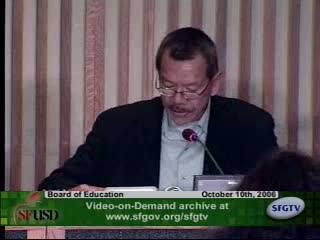
The San Francisco Police Department and district staff presented an update on the School Resource Officer (SRO) program at the Board meeting on Oct. 10, reporting staffing levels, incident counts and demographic breakdowns, and prompting extended questions from board members about data and policy.
Lieutenant Fatou said 30 officers serve SFUSD schools this year either full time or splitting time between sites, that SROs also teach gang-risk education and run youth programs, and that from August 28 through Oct. 6 the unit received 126 police reports after responding to 852 calls for service. For the 2005–06 school year the unit reported 219 total arrests, of which 194 occurred at school incidents. Fatou provided an ethnic breakdown that attributed roughly 44% of arrests to African American youth and identified battery, robbery, vandalism and aggravated assault among the highest offense categories.
Board members questioned whether the presence of SROs raises arrest rates by bringing police into schools, asked for comparisons with pre-SRO baselines and clarification about data categories (admonished/contacts versus booked arrests), and pressed for school-level and program-level breakdowns. Commissioner Kelly said he wanted staff to compare arrest counts with administrative discipline (suspensions and expulsions) because the district sees fewer expulsions than arrests for serious offenses. Commissioners asked that future reports separate middle- and high-school data and give the specific schools involved.
Lieutenant Fatou and police staff said many SRO interactions are non-arrest interventions and counseling; they described arrests as reserved for serious incidents such as assaults causing injury and robberies. Fatou also said that officers are conducting targeted patrols at transit corridors and bus stops (San Bruno corridor, 47/22 lines, 16th- and Utah-area routes), and noted efforts to coordinate with community-based organizations and the district’s prevention programs. The board discussed the Secure Our Schools grant and the district’s desire to pair SRO coverage with more community-based prevention and intervention services.
The Board asked staff to prepare a more detailed analysis for a future meeting: school-by-school breakdowns, historical comparisons with pre-SRO years, separation of contacts/admonishments from arrests, a count of SRO assignments by middle versus high schools, and an overview of prevention programs that could complement or reduce reliance on SRO responses.