Get Full Government Meeting Transcripts, Videos, & Alerts Forever!
Get email alerts on the Cultural Landmarks topic
No spam. Unsubscribe anytime.
Planning Commission legalizes Greg Angelo Museum’s public entertainment use, citing landmark protection
Summary
The Planning Commission approved a conditional use authorization to legalize the Greg Angelo Museum’s general entertainment use at 225 San Leandro Way (San Francisco Landmark No. 318), with hours and guest limits and conditions intended to protect neighbors; motion passed unanimously 6–0.
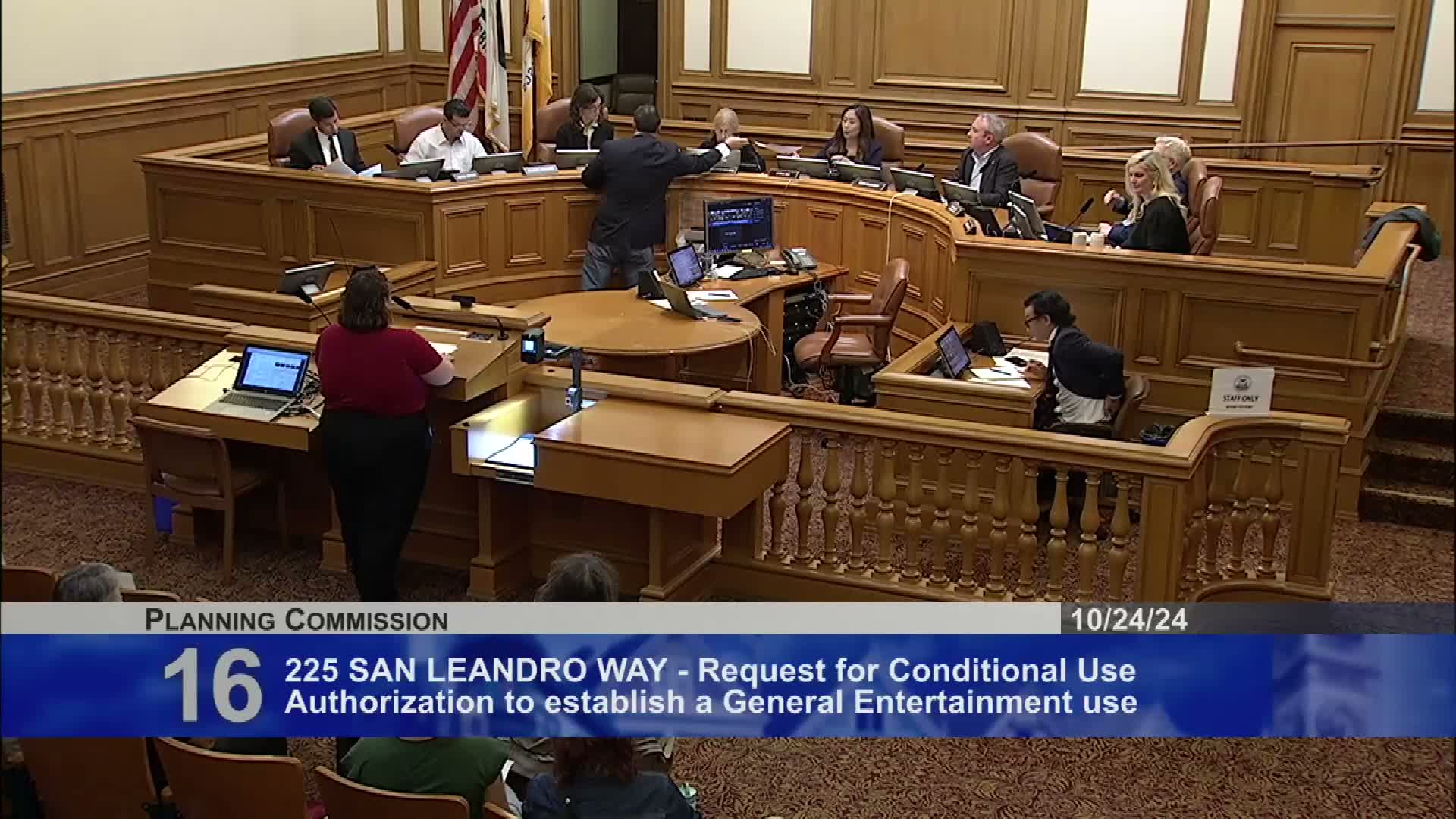
The San Francisco Planning Commission unanimously approved a conditional use authorization Oct. 24 to legalize the Greg Angelo Museum’s general entertainment use at 225 San Leandro Way, a property designated San Francisco Landmark No. 318.
Planning staff recommended approval with conditions, telling commissioners the authorization would help preserve the landmark’s character by legally recognizing the immersive art and performance activities that have operated from the residential property for roughly 35 years. The department noted the application does not propose expanding the building envelope or intensifying operations beyond current practice.
Project sponsor John Bradley (EAG Studio) and planning staff outlined operational limits included in the red‑line conditions: public tours roughly 10 a.m.–6:30 p.m. Thursday through Sunday (maximum 8 guests for routine tours); private tours, events and shows allowed up to 9:30 p.m. (with higher guest counts for private events — up to 25 for private shows and up to 40 for special events); and after 6:30 p.m. activities would occur indoors to limit neighborhood impacts. The staff report said the department received 22 public comments in support and two in opposition.
Dozens of speakers — including neighbors, artists and arts advocates — described the venue as a unique cultural resource that provides artist employment, mentorship and community healing. Several neighbors spoke in support; the Balboa Terrace Homeowners Association was identified in the record as having concerns about intensification and future enforcement through CC&Rs. Deputy City Attorney Austin Yang told commissioners that encumbrances such as CC&Rs are private contracts the city is not a party to; the commission’s action addresses compliance with the planning code and landmark findings, not private contractual obligations.
Commissioners praised the project’s contributions to cultural life in San Francisco. Vice President Moore moved to approve the conditional use with staff conditions; the motion passed unanimously 6–0.
Under the approval, the museum’s general entertainment use is allowed by conditional use because it is tied to the property’s character‑defining features as a designated landmark; any future different commercial use would require a separate conditional use review.