Get Full Government Meeting Transcripts, Videos, & Alerts Forever!
Get email alerts on the Housing Bmr topic
No spam. Unsubscribe anytime.
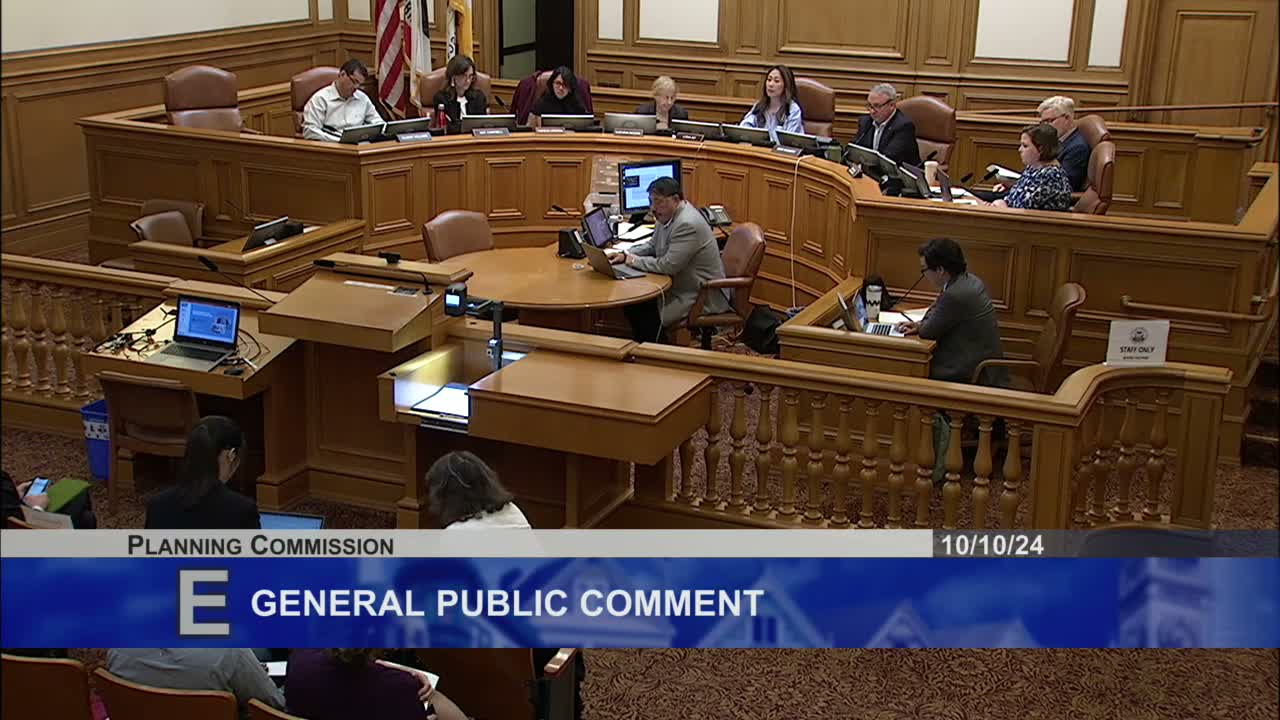
Planning commission weighs narrow fix to freeowners stuck by BMR resale rules; delays recommendation for a week
Summary
The Planning Commission considered an ordinance to let the mayor's office of housing and community development (MOHCD) raise some BMR resale prices and qualifying AMI for a small group of homeowners who bought above older resale formulas; after lengthy public testimony the commission failed a motion to recommend approval and instead continued the matter one week for follow-up data and possible sunset language.
The San Francisco Planning Commission on Oct. 10 considered a narrow ordinance, sponsored by Supervisor Matt Haney’s (sponsor identified in packet as Supervisor Melgar), that would allow limited adjustments to the affordable resale price and qualifying area median income (AMI) for certain below-market-rate (BMR) homeownership units.
Jen Lowe of the sponsor’s office told commissioners the change is targeted: it would let the mayor’s office of housing and community development (MOHCD) increase the affordable resale price up to 130% of AMI in cases where an owner purchased a unit at a higher price under older calculations, and increase the qualifying income for buyers up to 150% AMI in specific circumstances. “We took a long time to think through this,” Lowe said, adding the measure is meant to help a small number of homeowners without destabilizing the program.
MOHCD deputy director Maria Benjamin and Homeownership SF director Ceci Ng described how program rules and resale formulas evolved and how disclosure of a separate “affordable resale price” began in 2019. Benjamin said the department believes only a small number of existing BMR homeowners — staff estimated “about 100” as an upper bound, and identified roughly six active cases that might immediately benefit — would be eligible for the waiver. “We fixed the disclosure in 2019,” Benjamin said, and the proposed ordinance is intended as a narrowly targeted remedy for legacy cases.
Four homeowners and their real-estate agent — including Simon and Amy Jansook and agent Jennifer Rosendale — testified that they were unaware of the affordable resale-price mechanics when they bought and are now unable to sell without taking a large loss. "We were blindsided," Simon Jansook said. Rosendale said she had shown the Jansook unit to more than 100 potential buyers and nearly every buyer declined once they learned of the affordable resale restrictions.
Commissioners pressed MOHCD staff about the scope and risks: whether raising AMI could create unintended consequences for program affordability, how many units would be affected, and whether guardrails and reporting would be required. Commissioner Campbell proposed a motion to recommend approval with a staff-delegation modification and a one-year check-in report; the motion failed 3–3. Commissioners who opposed the motion urged stronger safeguards, a sunset or reporting cadence, and clearer data on the size of the affected universe.
After debate, the commission adopted an alternate motion to continue the matter one week (to Oct. 17) so staff and the sponsor’s office could provide additional data on how many units would be affected, language options for a sunset or reporting requirement, and clearer guardrails on any delegated administrative authority. That follow-up motion passed 5–1, with Commissioner Campbell voting no on the continuance.
What happens next: The commission’s recommendation (including any suggested sunset or reporting language) will go to the Board of Supervisors for final action. Staff and MOHCD agreed to return with more precise case counts and proposed reporting language at the next hearing.