Get Full Government Meeting Transcripts, Videos, & Alerts Forever!
Get email alerts on the Umu Laboratory Uses topic
No spam. Unsubscribe anytime.
Commission recommends disapproval of ordinance to ban labs in UMU, 4–3
Summary
The commission voted 4–3 to recommend disapproval of a Board of Supervisors ordinance that would prohibit laboratory uses in Urban Mixed Use (UMU) zoning. Staff and many speakers warned the ban could undercut local biotech jobs and the city’s economic recovery.
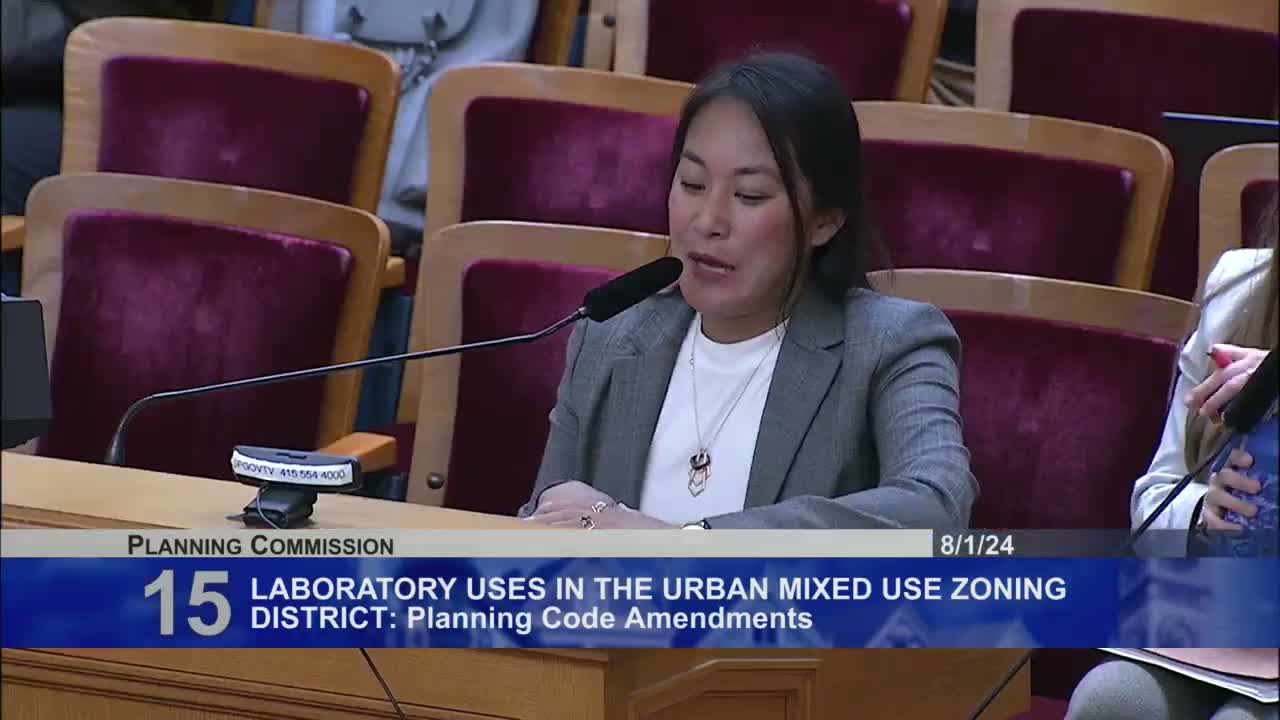
The Planning Commission on Aug. 1 recommended disapproval of an ordinance from the Board of Supervisors that would revise the definition of laboratory to explicitly cite biotechnology and would prohibit laboratory uses in UMU zoning, voting 4–3 to recommend disapproval.
Planning staff urged disapproval, saying the proposed ban is inconsistent with the general plan and could have broad, unintended effects across UMU districts that span Dogpatch, Mission Bay, SoMa and other neighborhoods. Veronica Flores, presenting staff’s analysis, said the proposal "does primarily two things" (add biotechnology examples to the definition and make labs not permitted in UMU) and concluded, "The department does not support this proposed ordinance." Staff cautioned it could push laboratory demand into PDR (production, distribution and repair) districts, adversely affecting industrial employers and the city’s ability to attract and retain life‑science companies.
Laurel Armani Tedes of the Office of Economic and Workforce Development warned commissioners that banning laboratories could reverse years of economic-development work and harm a sector that provides jobs across skill levels. She said the city’s previous efforts—pro-business permitting changes, economic development programs and targeted investments—could be undermined by a wholesale ban.
More than a dozen scientists, founders and representatives from trade groups testified in favor of keeping labs in UMU districts. Speakers argued labs create walkable, mixed-use neighborhood activity, provide training and entry-level jobs, and support startups that depend on proximity to talent and funders. Helen Chen, a molecular biologist and founder, said that enabling small biotech companies to operate locally "is like an engineer having a garage" and is essential to innovation.
Commissioners debated whether the ordinance addresses a clearly articulated problem and weighed land-use solutions, building and life-safety rules, and community concerns about lab building design and street activation. Several commissioners said the primary code definitions for "laboratory" and "life science" are confusing and would be better clarified with a land-use approach than a broad prohibition.
After deliberation the commission voted to recommend disapproval of the ordinance, 4–3. Commission records show that disapproval means the Planning Department’s formal recommendation to the Board of Supervisors is to not approve the ban as drafted. Staff noted the draft would not close existing legally established labs, but could prevent new lab projects from being approved in UMU and would affect projects that had not yet fully vested.
Next steps: the commission’s disapproval recommendation will be provided to the Board of Supervisors for its consideration when the ordinance is formally considered there. Staff recommended further code cleanup and suggested targeted land-use measures (e.g., active ground-floor commercial requirements) if the goal is to address street activation or neighborhood impacts rather than broadly banning labs.