Get Full Government Meeting Transcripts, Videos, & Alerts Forever!
Get email alerts on the Legal Privilege Disclosure topic
No spam. Unsubscribe anytime.
San Francisco Planning Commission asserts attorney–client privilege and votes to withhold closed‑session disclosures
Summary
The San Francisco Planning Commission voted unanimously May 23 to assert attorney–client privilege for listed matters, then voted to withhold disclosure of closed‑session discussions; staff reported no action was taken during the closed session. A public commenter urged greater transparency.
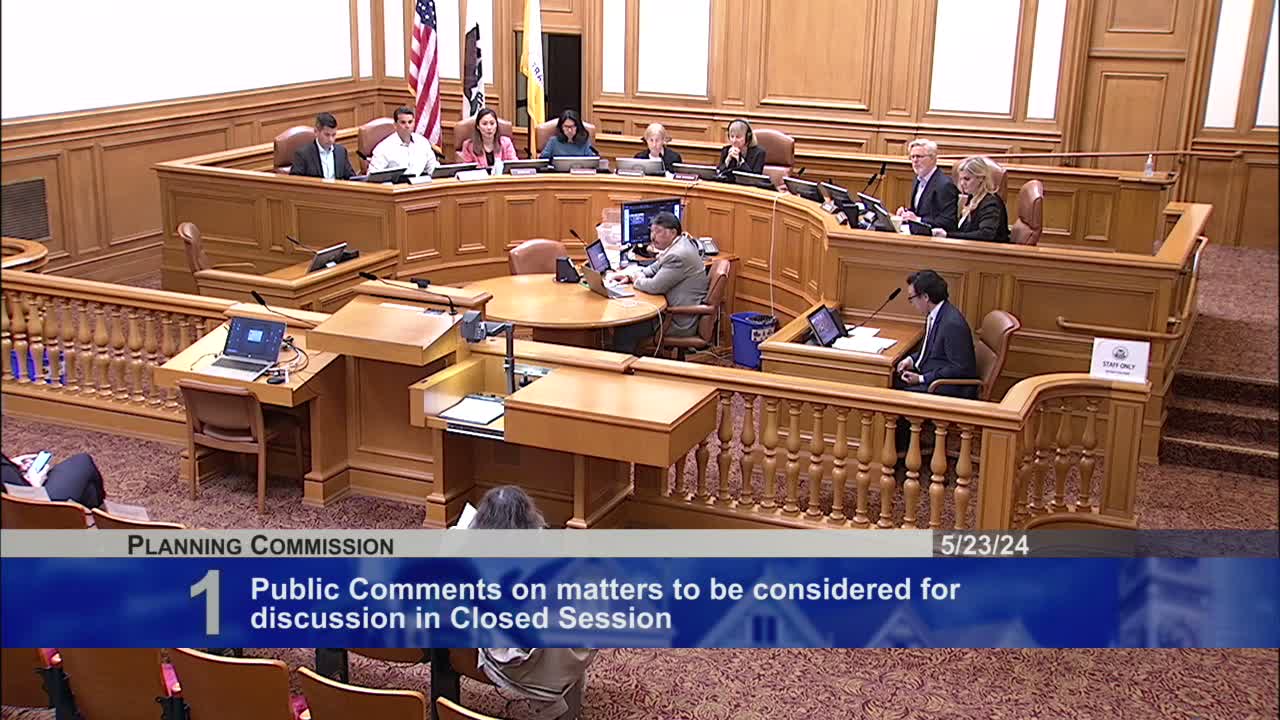
The San Francisco Planning Commission voted unanimously on May 23 to assert attorney–client privilege over matters discussed in closed session and then voted to withhold any disclosure of those discussions.
During a brief public‑comment period before the commission locked its doors for closed session, Georgia Shutish urged the body to allow the public to hear portions of the conversation, saying, “I, I think it would be really nice if the public could hear some of this because the public alerted the staff and the commission and the board of supervisors to the fact of the UDU.”
After public comment closed, Vice President Moore moved to assert attorney–client privilege for the items listed for conference with legal counsel; the motion passed on a roll‑call vote with Commissioners Soh, Williams, Braun, Imperial, Vice President Moore and Commission President Diamond voting “Aye,” for a 6‑0 result. The commission then met in closed session; staff later reported that “there was no action taken” during that closed session.
The commission returned to consider whether to disclose any portion of the closed‑session discussions and Vice President Moore moved that the commission not disclose any portion. That motion also passed unanimously, with the same six commissioners recorded as voting “Aye.”
The meeting record shows no named second for either motion in the transcript. After the votes, the chair concluded the closed session and the commission recessed for five minutes before proceeding to the regular calendar.
The meeting did not identify any formal decisions, contracts or ordinance adoptions made during the closed session; staff expressly reported no action had been taken while the commission was behind closed doors. The decisions recorded in the open session were limited to procedural motions about privilege and disclosure.